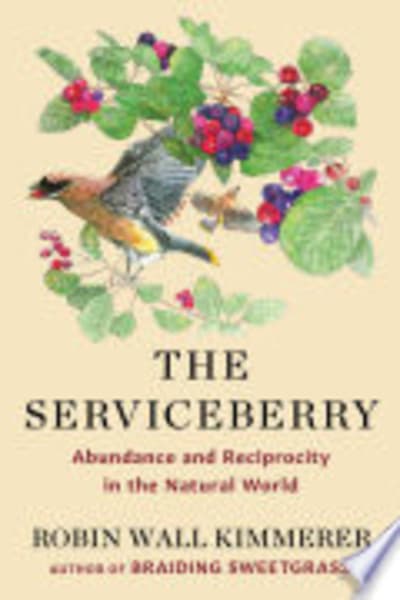
The Serviceberry — Book Summary & Review
Last updated:
The Serviceberry Summary
In The Serviceberry, Robin Wall Kimmerer builds her argument around an Indigenous idea of reciprocity and then stress-tests it with a single, stubbornly ordinary tree: the serviceberry. Kimmerer doesn’t treat the plant as scenery. She treats it as a teacher with a job to do—one that shares sweetness through birds, seasons, and mutual dependence rather than through hoarding or “self-sufficiency.” The book’s structure feels like a set of short, lyrical essays that circle the same moral problem from different angles: what we value, why our economy rewards extraction, and how gratitude can be practiced as a living economic relationship. Kimmerer’s gift-economy framing is where the book lands hardest. She contrasts a scarcity-and-competition mindset with a reciprocity model where “wealth” comes from the quality of relationships, not from domination. She also keeps returning to the serviceberry’s concrete biology—its abundance timed to community needs—and uses that timing as an ethical analogy: distribution sustains the distributor. One of her most memorable moves is pairing observation with responsibility: to notice abundance is to ask what you owe back, and to ask what you owe back is to reorient your daily choices.
Kimmerer can be frustrating if you want a tight, secular policy blueprint or a step-by-step system you can implement tomorrow. This is not that kind of book. It also leans heavily on Indigenous knowledge frameworks that may feel unfamiliar or rhetorically “prayer-like” to readers who prefer strictly scientific exposition. Still, for anyone willing to sit with the discomfort of changing what counts as success, The Serviceberry offers a bracing alternative to the values we’ve inherited, and Kimmerer’s insistence on reciprocity is hard to shake even after the last pages.
Key Takeaways from The Serviceberry
-
1
Reciprocity ethic: Kimmerer frames giving as a relationship obligation, not a transaction, and she ties it to how the serviceberry shares abundance.
-
2
Gift economy: she contrasts hoarding and scarcity with a values system where “wealth” is measured by relationship quality and mutual flourishing.
-
3
Gratitude as practice: gratitude isn’t sentiment; it becomes a behavioral stance that changes what you take, how you notice, and what you return.
-
4
Serviceberry as model: the tree’s timed distribution to birds and community functions as an ethical analogy to human economies.
-
5
Interconnectedness: Kimmerer argues that survival is relational, so independence-as-ideal produces harm when it ignores dependencies.
Who Should Read This
Someone who feels morally tired by scarcity talk and corporate “success” metrics will likely find Kimmerer’s reciprocity lens clarifying. If you’re trying to live more responsibly but keep falling into guilt or vague good intentions, this book gives you a sturdier framework than vibes.
Who Shouldn't Read This
Someone who wants a practical, secular action plan—complete with policy steps or measurable interventions—will come away irritated by the book’s essayistic, values-forward approach. If you strongly prefer dense science or straightforward argumentation over lyrical moral reflection, Kimmerer’s tone may feel too devotional to stick.
Editor's Verdict
The Serviceberry’s best move is using the serviceberry’s real-world “distribution” patterns as an ethical model for reciprocity, especially in the way Kimmerer links observation to obligation. The real limitation is that it won’t satisfy readers seeking a concrete how-to program; it stays at the level of moral reorientation and relationship thinking. This book hits hardest for anyone who’s burned out on productivity and money-as-meaning frameworks and is ready to question what “wealth” even means.
Ready to read The Serviceberry?
Get your copy on Amazon today.
The Serviceberry — Frequently Asked Questions
About Robin Wall Kimmerer
Robin Wall Kimmerer is a botanist, professor, and member of the Citizen Potawatomi Nation. She teaches Indigenous science and environmental stewardship and writes from her experience working with plants and ecosystems, making her credible to discuss native trees and their ecological and cultural roles. Her book The Serviceberry (2012) blends natural history with Indigenous teachings. Other notable works include Braiding Sweetgrass (2013) and Gathering Moss (2003).