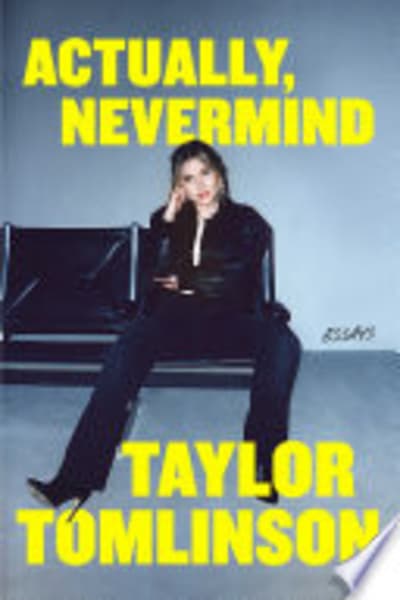
Actually, Nevermind — Book Summary & Review
Last updated:
Actually, Nevermind Summary
Actually, Nevermind is built as a set of essays where Taylor Tomlinson keeps reopening the same questions—fear, ambition, identity—and then shows her opinions changing in real time, not as a neat arc. The book’s spine is her mother’s death and the age pressure of “thirty-four,” and Tomlinson uses that anchor to talk about how grief makes you both more cautious and more impulsive. One of the clearest examples is her section on therapy and mental health, where she argues that “knowing your tools” can still leave you terrified when life changes the rules. She also turns the lens on being the eldest daughter, and the way that role quietly trains you to treat reassurance like a resource you have to earn. Later, she leans into late-night TV as a specific identity problem: the only woman in the room, the expectations, the jokes that land differently when you’re the exception. Even when Tomlinson is riffing about religion, sex, food, or body image, the jokes keep snapping back to the same theme—certainty feels good, but it can also be a trap. A recurring move in Actually, Nevermind is her willingness to retract herself. She’ll make a claim, then admit she’s changed her mind, and she treats that reversal as evidence of growth rather than failure. Her “real maturity” line—emotionally flexible, not physically flexible—works like a thesis for the whole book, because she keeps choosing adaptability over performance. Honest limitation: if you want a single, sustained argument with chapters that build toward one conclusion, Tomlinson’s essay structure will feel more like a series of candid conversations than a tightly engineered system.
Enjoyed this one? Read these next.
Top picks in Non-Fiction, chosen for readers of Actually, Nevermind.
Sapiens
by Yuval Noah Harari
Check price on Amazon
Educated
by Tara Westover
Check price on Amazon
Becoming
by Michelle Obama
Check price on Amazon
The Wright Brothers
by David McCullough
Check price on AmazonKey Takeaways from Actually, Nevermind
-
1
Thirty-four as a clock: Tomlinson uses her mother’s death-age to show how time pressure warps ambition and fear.
-
2
Flexible certainty: She treats fixed opinions as emotionally expensive, arguing that changing your mind is a skill.
-
3
Therapy as practice: Therapy isn’t a permanent personality upgrade; it’s a set of tools that still fail under real stress.
-
4
Eldest daughter conditioning: She explains how responsibility becomes a reflex, turning reassurance into something you “owe.”
-
5
Late-night TV exception: Being the only woman shapes her identity, changing how she reads power, humor, and belonging.
Who Should Read This
Someone who’s been trying to “optimize” their life lately—sleep, mindset, therapy, routines—while still feeling anxious will recognize themselves quickly. If you’re stuck between wanting independence and needing reassurance, Tomlinson’s shifting opinions will feel both funny and strangely permission-giving.
Who Shouldn't Read This
If you want a linear self-help program with exercises you can follow step-by-step, Actually, Nevermind will frustrate you because it’s essay-based and argument-light. If your grief is fresh and you’re looking for gentle distance from death talk, Tomlinson’s recurring mother/age framing may feel too direct and too personal.
Editor's Verdict
The best part of Actually, Nevermind is Tomlinson’s use of retracting herself—especially in the therapy-and-mental-health essays—where she shows growth as messy revision rather than a victory lap. The limitation is that the book doesn’t aim to solve anything with a unified framework; it prioritizes honesty and comedy over a structured takeaway. This lands hardest for anyone in their late twenties or early thirties who feels the calendar tightening and wants permission to stop pretending they’re “sure.”
Ready to read Actually, Nevermind?
Get your copy on Amazon today.
Actually, Nevermind — Frequently Asked Questions
About Taylor Tomlinson
Taylor Tomlinson is an American stand-up comedian, writer, and podcast host. She began performing comedy in her teens and later gained wide recognition through Netflix specials. She is credible on the topic of modern dating and relationships because her work draws from years of firsthand experiences and extensive observational comedy on those subjects. Besides Actually, Nevermind, she has released the Netflix special Look at You (2019) and the book Higher or Lower? (2021).