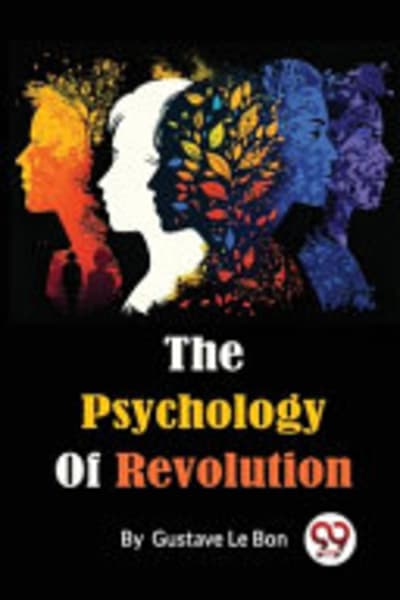
The Psychology of Revolution — Book Summary & Review
Last updated:
Public domain via Project Gutenberg — free and legal.
The Psychology of Revolution Summary
Le Bon organizes The Psychology of Revolution around a blunt crowd psychology: individuals supposedly “de-individualize” inside crowds, and that mental shift is what makes revolutionary surges possible. The book’s core move is to treat political upheaval less as a rational response to grievances and more as an emotional contagion managed by symbols, leaders, and propaganda. Le Bon returns again and again to the idea that collective belief—what he frames as a shared cause plus group identity—overrides evidence, so the crowd becomes easier to steer. He also leans hard on the leader’s toolkit: repetition, emotional appeals, and the strategic use of fear or hope to mobilize mass behavior.
One concrete section that sticks is Le Bon’s discussion of “crowds” and their alleged irrationality, where he argues that mass action follows patterns that skilled manipulators can predict and exploit. Even when you disagree with the certainty of his claims, the logic is consistent: if emotions and suggestion dominate, then revolutions can accelerate quickly once a narrative catches fire. Le Bon’s treatment of revolutionary leaders is similarly direct—he portrays them as technicians of belief rather than philosophers of justice.
Honest limitation: this is not a balanced study of revolutions’ economics or institutions, and it rarely gives you modern, testable evidence. If you want nuance, data, or humane empathy for historical movements, Le Bon will frustrate you. The writing is more sweeping diagnosis than careful casework, and the “crowds are irrational” premise can feel like a convenient shortcut rather than a demonstrated conclusion.
Key Takeaways from The Psychology of Revolution
-
1
Crowd psychology: Le Bon argues individuals lose self-control in crowds, which makes collective behavior faster and easier to manipulate.
-
2
Collective belief: revolutions, in Le Bon’s framing, hinge on shared conviction and group identity more than on facts or policy details.
-
3
Revolutionary leaders: Le Bon treats leaders as managers of emotion, using symbols, repetition, and fear/hope to steer masses.
-
4
Suggestion and propaganda: he emphasizes how repeated messaging can override judgment, turning vague discontent into coordinated action.
-
5
De-individualization: the book’s recurring claim is that anonymity dissolves personal restraint, raising the odds of violence.
Who Should Read This
If you’re trying to understand why political movements can ignite even when people lack clear plans or credible evidence, Le Bon gives you a psychological template. Someone who studies persuasion, radicalization, or group behavior and wants a ruthless, theory-first account will likely get traction from Le Bon.
Who Shouldn't Read This
If you want a modern, evidence-heavy sociology of revolutions with case studies and data, Le Bon’s sweeping crowd claims will feel lazy. If you’re sensitive to deterministic language—especially the idea that crowds are inherently irrational—you’ll probably feel preached at rather than persuaded.
Editor's Verdict
The single best thing Le Bon does is lay out a coherent crowd-mechanics theory, especially in his sections on crowds and how belief spreads through suggestion and propaganda. The real limitation is that Le Bon offers few verifiable details and treats “irrational crowds” as a default assumption, not a hypothesis. This hits hardest for anyone working on political messaging, radicalization research, or activism strategy and needing a theory of how emotion beats argument in real time.
Ready to read The Psychology of Revolution?
Get your copy on Amazon today.
The Psychology of Revolution — Frequently Asked Questions
About Gustave Le Bon
Gustave Le Bon (1841–1931) was a French physician, psychologist, and social theorist. He studied human behavior in crowds and wrote about mass psychology and political change, making him a credible commentator on revolutionary dynamics. His works include The Psychology of Revolution (1895) and The Crowd: A Study of the Popular Mind (1895). He also authored The Psychology of Socialism (1896).