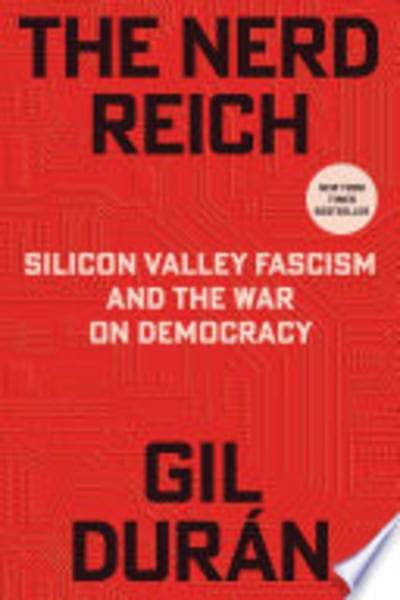
The Nerd Reich — Book Summary & Review
by Gil Durán
Last updated:
The Nerd Reich Summary
In The Nerd Reich, Gil Durán builds his core argument around the idea that technocratic ideology—rooted in The Sovereign Individual—migrated from fringe theory into a practical political program led by Silicon Valley billionaires. Durán doesn’t keep the thesis abstract; he anchors it in specific casework, starting with San Francisco’s “weaponized elections” and the culture of “innovation” used to excuse democratic erosion. He repeatedly connects the early promise of technological liberation to a later, harder reality: corporate rule by other means, enforced through capital, platforms, and policy capture. Durán’s through-line is that the movement treats elected government as a problem to bypass, not a system to improve.
One of the book’s most useful moves is the way Durán traces strategy, not just personalities. He lays out how ideas from Davidson and Rees-Mogg become talking points, then become funding priorities, then become operational influence—through think tanks, lobbying, crypto-financed projects, and algorithmic propaganda. The chapters on Peter Thiel, Marc Andreessen, Balaji Srinivasan, and Elon Musk read like a roster of overlapping roles: philosopher, venture architect, accelerationist, and media-scale amplifier. Durán also spends time on the modern infrastructure of persuasion—social media attention economies and AI-driven targeting—arguing that “consent” is being engineered rather than won.
Still, Durán’s book has a limitation: it’s more interested in exposing the movement’s ideology and infrastructure than in offering a detailed, step-by-step playbook for specific local resistance campaigns. If you want a nuts-and-bolts civic guide, The Nerd Reich may frustrate you.
Key Takeaways from The Nerd Reich
-
1
The Sovereign Individual framing: Durán treats it as an ideological origin story for replacing elections with market-managed authority.
-
2
Weaponized elections: he shows how local political systems can be gamed through money, influence operations, and institutional friction.
-
3
Digital feudalism: Durán argues platforms and crypto create dependence structures that mimic medieval hierarchy in modern form.
-
4
Algorithmic propaganda: he connects AI targeting and social feeds to the manufacturing of consent, not just information flow.
-
5
Resistance roadmap: Durán ends by urging action, but he focuses more on diagnosis than on operational tactics.
Who Should Read This
Someone who’s watched tech executives talk about “innovation” while democratic norms erode and wonders how that translation happens will likely feel seen. If you’re burned out by vague political commentary and want a named, connected account of Durán’s tech-authoritarian pipeline, pick this up.
Who Shouldn't Read This
If you’re looking for a detailed, local-organizing manual with clear steps you can follow tomorrow, Durán won’t deliver that. If you hate investigative writing that leans dense and argument-driven, The Nerd Reich may feel relentlessly heavy.
Editor's Verdict
The single best thing Durán does is connect theory to mechanism, especially through his discussion of “weaponized elections” and how billionaire influence turns philosophy into operational power. The real limitation is that Durán stays at the level of ideology and infrastructure more than he provides practical, step-by-step resistance instructions. This lands hardest for anyone mid-career who’s been paying attention to politics but still thinks the threat is only about coups, not code, capital, and platform persuasion.
Ready to read The Nerd Reich?
Get your copy on Amazon today.
The Nerd Reich — Frequently Asked Questions
About Gil Durán
Gil Durán is the author of The Nerd Reich. He writes about technology, computing culture, and the social history of digital systems, drawing on his experience studying how technical communities form and influence ideology. His credibility on the topic comes from his focus on primary historical and technical context rather than speculation. Other notable works by Gil Durán are not consistently documented in major bibliographic sources.