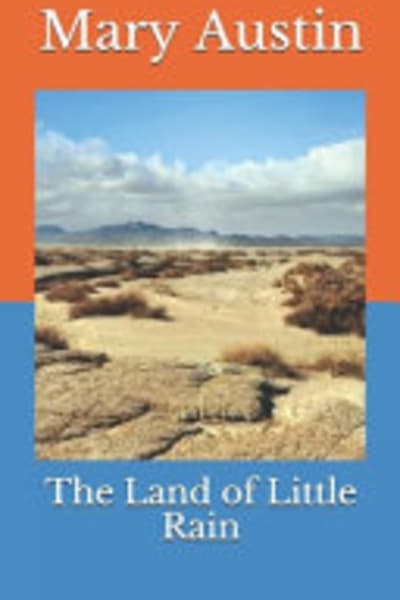
The Land of Little Rain — Book Summary & Review
by Mary Austin
Last updated:
Public domain via Project Gutenberg — free and legal.
The Land of Little Rain Summary
In The Land of Little Rain, Mary Austin builds the book around a seasonal logic—how “little rain” reshapes every plant, animal, and human routine in the California desert—so the climate is never backdrop, it’s the main character. Austin moves through regions south of Yosemite and uses short, vivid sections to stitch together natural history with social observation: Ceriso country, Death Valley, the Mojave, and towns like Jimville, Kearsarge, and Las Uvas. One recurring framework is her attention to water as a system: where it pools, what it feeds, what it prevents, and how that scarcity forces daily choices. She also gives you people in the same breath as the landscape—Ute, Paiute, Mojave, and Shoshone communities alongside European-American gold prospectors and borax miners, plus descendants of Hispanic settlers—then shows how each group’s habits respond to the same harsh arithmetic.
A concrete example of her method is the way Austin treats desert plants not as “pretty” specimens but as evidence of adaptation, then links those adaptations to visibility, shelter, and even movement across the land. When she describes animals, she doesn’t just list them; she places them into an ecological calendar, so you feel how timing matters more than strength. Austin’s eye for human labor shows up too: prospecting and mining are portrayed as temporary intensifications of hope, and the desert’s resistance is quietly relentless.
Here’s the limitation: The Land of Little Rain doesn’t offer a sustained plot or a modern-style argument you can quote in one page; it’s a mosaic of description and local history that may frustrate anyone wanting narrative momentum. If you buy it expecting a conventional frontier story, Austin will keep you in observation mode—often rewarding, occasionally stubbornly non-linear.
Key Takeaways from The Land of Little Rain
-
1
Little rain as structure: Austin treats drought as the organizing principle for plants, animals, and daily schedules, not scenery.
-
2
Ceriso country sketches: Her section-by-region approach turns geography into a way of reading behavior and ecology together.
-
3
Desert adaptation details: She describes vegetation as functional evidence—shade, water use, and survival strategies you can almost map.
-
4
Native life alongside mining: Austin places Ute, Paiute, Mojave, and Shoshone communities in the same ecological frame as prospectors.
-
5
Seasonal ecological calendar: Animals and people are timed to rainfall patterns, so “when” matters as much as “where.”
Who Should Read This
Someone who’s stuck in a workday rut and wants a book that makes you look at the world’s constraints—weather, water, time—can find this grounding. If you’re craving local, place-specific writing and you enjoy learning how ecosystems shape culture, Austin’s observations will feel personal.
Who Shouldn't Read This
If you need a continuous plot with escalating stakes, The Land of Little Rain will feel like stops and starts rather than momentum. If you want modern academic framing or a clearly signposted thesis, Austin’s mosaic style may frustrate you.
Editor's Verdict
The single best thing The Land of Little Rain does is fuse natural history with social detail through Austin’s recurring water-and-season framework, where her descriptions of plants and animals directly explain human routines. The real limitation is that the book stays in observational fragments instead of building a conventional narrative or sustained argument. This hits hardest for anyone who’s grown tired of generic nature writing and wants to understand how scarcity organizes real life.
Ready to read The Land of Little Rain?
Get your copy on Amazon today.
The Land of Little Rain — Frequently Asked Questions
About Mary Austin
Mary Austin (1868–1934) was an American writer and poet known for works about the American Southwest. Raised in California, she became closely familiar with desert landscapes and Indigenous cultures through extensive travel and observation. Her firsthand knowledge of arid regions and their ecology and history makes her credible for writing about the desert environment. She also wrote The Arrow-Maker (1911) and The Flock (1906).