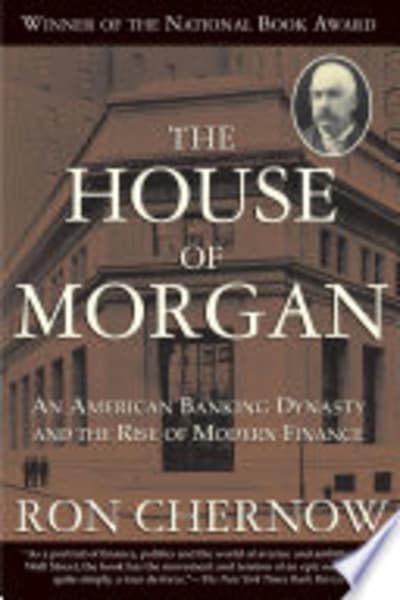
The House of Morgan — Book Summary & Review
by Ron Chernow
Last updated:
The House of Morgan Summary
Chernow opens with the intriguing concept of the “Morganization”—a term he uses for the aggressive restructuring tactics J.P. Morgan employed to consolidate and control industries. The book is divided into four parts, each marking a distinct era of the Morgan empire, from its roots in London to the tangled web of influence it built across the Atlantic. One especially engaging section, “The Corner,” recounts the infamous confrontation with Cornelius Vanderbilt, exposing the cutthroat machinery of Gilded Age finance. Chernow meticulously tracks the rise and collapse of power within the Morgan dynasty, offering vivid portraits of Pierpont and Jack Morgan. Still, the book leans hard on dense financial jargon, which will frustrate readers who don’t already speak banking. For anyone wanting an exhaustive account of the Morgans’ impact on global finance, it delivers—though casual readers may find the level of detail exhausting.
Key Takeaways from The House of Morgan
-
1
Morganization: Chernow describes J.P. Morgan's strategy of consolidating companies to eliminate competition and stabilize industries.
-
2
The House of Morgan: A term used by Chernow to encapsulate the extensive influence of the Morgan family across global finance.
-
3
The Panic of 1907: An event where J.P. Morgan intervened to stabilize the financial markets, showcasing his power and influence.
-
4
Glass-Steagall Act: Chernow discusses how this act split commercial and investment banking, affecting the Morgan empire's operations.
-
5
The Paternalistic Firm: Chernow explains how the Morgans viewed their employees as family, yet maintained strict control over their lives.
Who Should Read This
Someone who is fascinated by the historical impact of finance on global politics will find this book enlightening. If you're grappling with understanding the roots of modern banking systems, Chernow's detailed account will be invaluable.
Who Shouldn't Read This
If you're looking for a light read or are easily intimidated by dense financial terminology, this book will likely frustrate you. Those uninterested in detailed historical narratives might find the extensive coverage of the Morgan family's minutiae tedious.
Editor's Verdict
Chernow excels at weaving a comprehensive narrative of the Morgans' influence, particularly in the chapter 'The Banker's Banker.' The book's real limitation is its dense financial terminology, which may alienate those not versed in banking. This is ideal for history buffs or anyone at a crossroads in their career, seeking to understand how past financial giants shaped today's economic landscape.
Ready to read The House of Morgan?
Get your copy on Amazon today.
The House of Morgan — Frequently Asked Questions
About Ron Chernow
Ron Chernow is an American historian and biographer born on March 3, 1949, in Brooklyn, New York. He holds a degree in English from Yale University and an MBA from Cambridge University. Chernow is renowned for his comprehensive research and narrative style, which establish his credibility in financial history. Besides "The House of Morgan," he authored "Alexander Hamilton" and "Washington: A Life," both of which won prestigious awards, including the Pulitzer Prize for Biography.