The Happiness Hypothesis — Book Summary & Review
Last updated:
The Happiness Hypothesis Summary
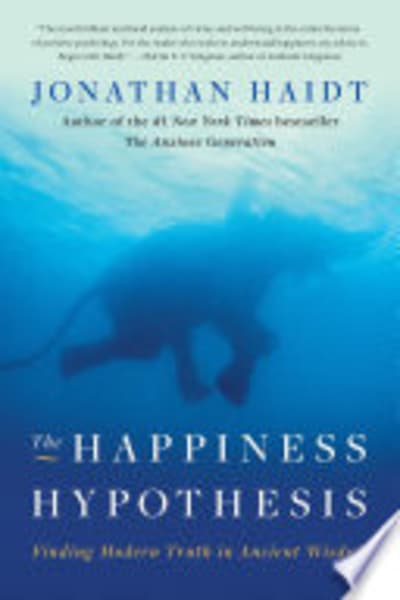
Jonathan Haidt introduces a fascinating framework in 'The Happiness Hypothesis' with the equation H=S+C+V, where happiness equals your biological setpoint, conditions of your life, and voluntary activities. The book is structured around ancient wisdom, juxtaposed with modern psychological research, to explore what truly makes us happy. In Chapter 2, 'Changing Your Mind,' Haidt examines how our minds can be both our best friends and worst enemies, drawing on the analogy of a rider and an elephant. He successfully intertwines insights from Buddha, Plato, and modern science to suggest that understanding our mind's dual nature is crucial for happiness. However, the book doesn't deeply explore the nuances of socio-economic influences on happiness, which might frustrate readers looking for a more comprehensive analysis of external factors.
Key Takeaways from The Happiness Hypothesis
-
1
The Rider and the Elephant: Represents the conscious and automatic parts of the brain, emphasizing their need for harmony.
-
2
The Happiness Formula: H=S+C+V is a mathematical approach to understanding the components of personal happiness.
-
3
Vital Engagement: A state of being fully absorbed and connected, akin to the concept of 'flow' in positive psychology.
-
4
Divinity with or Without God: Explores how feelings of transcendence can occur with or without religious belief.
-
5
The Cortical Lottery: The idea that our genetic predispositions significantly influence our baseline level of happiness.
Who Should Read This
If you're struggling to balance ancient philosophy with modern psychological practices, this book offers a structured approach. Someone who is curious about the science behind happiness will find Haidt's blend of research and storytelling enlightening.
Who Shouldn't Read This
If you're looking for an exhaustive analysis on how socio-economic status affects happiness, this book will leave you wanting. Those who prefer a straightforward, data-driven approach may find Haidt's philosophical discussions overly abstract.
Editor's Verdict
The book excels in its ability to weave ancient wisdom with modern psychological insights, as seen in the concept of 'Vital Engagement.' Its limitation lies in the lack of depth regarding socio-economic factors influencing happiness. Anyone navigating the complexities of happiness in a fast-paced world will find this book particularly resonant after a period of self-doubt or existential questioning.
Ready to read The Happiness Hypothesis?
Get your copy on Amazon today.
The Happiness Hypothesis — Frequently Asked Questions
About Jonathan Haidt
Jonathan Haidt is a social psychologist and professor at New York University’s Stern School of Business. He earned his Ph.D. in psychology from the University of Pennsylvania. Haidt is credible on the topic of happiness and morality due to his extensive research in moral psychology. Besides "The Happiness Hypothesis," he authored "The Righteous Mind: Why Good People Are Divided by Politics and Religion" and co-authored "The Coddling of the American Mind."