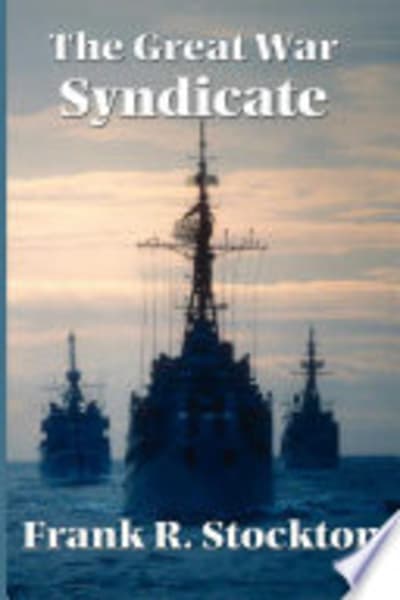
The Great War Syndicate — Book Summary & Review
Last updated:
Public domain via Project Gutenberg — free and legal.
The Great War Syndicate Summary
The Great War Syndicate is built around a looming late-1800s U.S.–Britain rupture, and it uses that geopolitical pressure to frame a very particular “war” machine: a small set of conspirators and their information network operating through maritime routines like the fishing schooner Eliza Drum. Stockton sets the first act in Maine, then pivots to Newfoundland as the crew’s ordinary labor becomes a surveillance pipeline—weather, routes, and cargo details turning into leverage. The story’s structure feels episodic, but it’s disciplined: each stop tightens the reader’s sense that the syndicate isn’t a gang so much as an organized system for manufacturing outcomes.
Stockton’s best trick is how he turns naval logistics into suspense. Instead of grand speeches, you get practical observations—how ships move, how delays compound, how rumors travel faster than facts. The “syndicate” concept works like a lens: once you see it, every coincidence looks engineered. Stockton also keeps the science-fiction angle grounded in period plausibility: not ray-guns, but the idea that coordination, communication, and secrecy can outperform brute force. When the plot finally escalates toward open confrontation, it doesn’t feel like a random climax; it feels like the payoff of earlier, quieter mechanisms.
One concrete example: the schooner’s departure and the careful attention to timing and reporting aren’t filler—they establish the story’s core claim that intelligence can be more decisive than firepower. Another example is how the book treats the ocean as an information highway, where distance doesn’t protect anyone; it just slows the reveal.
Honest limitation: this is short and compressed, so Stockton doesn’t linger long on character psychology or offer a fully explained “how it all works” blueprint. If you want deep emotional arcs or a neatly documented conspiracy rationale, you’ll finish feeling more impressed than satisfied—because Stockton prioritizes momentum and system over backstory.
Key Takeaways from The Great War Syndicate
-
1
U.S.–Britain strain: Stockton treats diplomatic tension as the story’s engine, making everyday maritime movement feel like pre-war preparation.
-
2
Eliza Drum route logic: The schooner’s timing and reporting function as an intelligence workflow, not mere setting or background color.
-
3
Syndicate as system: Stockton frames the “syndicate” less as villains and more as coordinated infrastructure for producing outcomes.
-
4
Naval logistics as suspense: Delays, weather, and navigation details create tension by showing how control of information beats force.
-
5
Period-plausible science fiction: The speculative element emphasizes communication and secrecy rather than futuristic weapons or hard explanations.
Who Should Read This
If you’re the kind of reader who likes conspiracies to feel procedural—built from routes, timing, and information flow—this will scratch that itch. Someone who’s tired of modern techno-thrillers that rely on jargon will appreciate Stockton’s late-1800s, logistics-first approach.
Who Shouldn't Read This
If you want rounded character development and a slow, emotional build, Stockton’s compressed structure will feel frustrating. If you need the conspiracy’s mechanics spelled out step-by-step, Stockton leaves too much implied and moves on.
Editor's Verdict
The single best thing The Great War Syndicate does is convert the Eliza Drum’s voyage into a working model of how intelligence networks operate, with timing and reporting doing the heavy lifting. The real limitation is that the story stays more schematic than psychological, offering fewer character interiors and less explicit “explanation” than some readers will want. This will hit hardest for readers who enjoy short alternate-history-style fiction and want to see geopolitical pressure translated into practical, maritime suspense.
Ready to read The Great War Syndicate?
Get your copy on Amazon today.
The Great War Syndicate — Frequently Asked Questions
About Frank R. Stockton
Frank R. Stockton (1834–1902) was an American writer and educator. He taught at the U.S. Naval Academy and later served as a school principal, giving him direct experience with military institutions and disciplined public service. Stockton is credible on war-related themes through his extensive nonfiction and fiction about conflict, including The Great War Syndicate (also published as The Great War Syndicate: A Story of the Great War). Other notable works include The Lady or the Tiger? and The Casting Away of Mrs. Leeks and Other Stories.