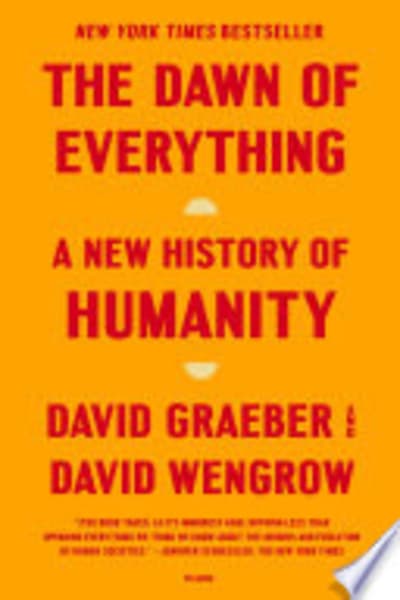
The Dawn of Everything — Book Summary & Review
by David Graeber & David Wengrow
Last updated:
The Dawn of Everything Summary
Graeber and Wengrow kick off 'The Dawn of Everything' with a provocative challenge to the conventional 'Agricultural Revolution' narrative, arguing against the idea that agriculture inevitably led to hierarchical societies. In the chapter 'Why the State Has No Origin', they dismantle the linear progression myth of human societies moving from simple to complex. The authors draw on examples from ancient cities like Çatalhöyük to illustrate diverse forms of social organization that defy common assumptions. Graeber and Wengrow's approach is both refreshing and daunting as they weave through archaeology, anthropology, and history with a density that requires patience. While their intellectual ambition is commendable, some readers might find the book's hefty length and deep academic dives a bit overwhelming or overly detailed for casual reading.
Key Takeaways from The Dawn of Everything
-
1
'Agricultural Revolution': Graeber and Wengrow contest the notion that agriculture directly leads to social hierarchies, presenting alternative societal evolutions.
-
2
'Çatalhöyük's Example': This ancient city exemplifies non-hierarchical social organization, challenging the idea that cities require centralized power.
-
3
'The Ubiquity of Play': They argue that much of human history involved playful social experiments, not rigid progression toward modern states.
-
4
'The Myth of the Innocent Savage': The book debunks the binary view of ancient humans as either noble savages or brutish primitives.
-
5
'Seasonal Societies': They introduce the concept of societies that change structures with seasons, showing flexibility in social organization.
Who Should Read This
Someone who feels trapped by conventional narratives of history and seeks a fresh perspective on societal development. If you've ever questioned the inevitability of modern political structures, this book provides alternative viewpoints.
Who Shouldn't Read This
Those looking for a light read will be disappointed by the dense academic content and extensive footnotes. If you prefer straightforward historical narratives without complex theoretical frameworks, this book may not suit your taste.
Editor's Verdict
The most striking aspect of 'The Dawn of Everything' is its challenge to the 'Agricultural Revolution' narrative, as highlighted in the chapter 'Why the State Has No Origin'. The book's real limitation is its density, which may alienate those without a strong interest in academic discourse. It's perfect for history enthusiasts feeling disillusioned with traditional narratives and seeking a more nuanced understanding of societal evolution.
Ready to read The Dawn of Everything?
Get your copy on Amazon today.
The Dawn of Everything — Frequently Asked Questions
About David Graeber & David Wengrow
David Graeber was an anthropologist and anarchist known for his work on social theory, notably "Debt: The First 5,000 Years." He held a Ph.D. from the University of Chicago and taught at the London School of Economics. David Wengrow is an archaeologist with a focus on early societies, holding a professorship at University College London. Together, they authored "The Dawn of Everything," drawing on their expertise in anthropology and archaeology to challenge conventional narratives of human history.