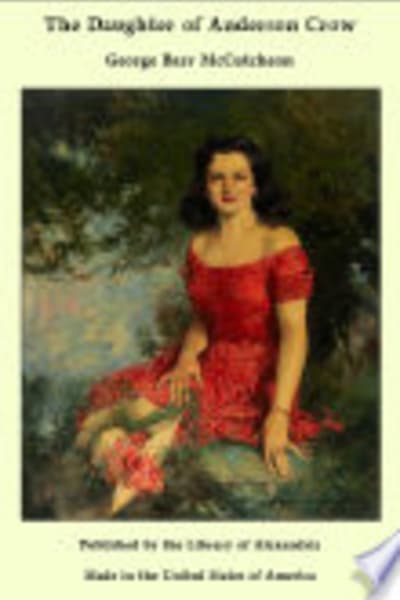
The Daughter of Anderson Crow — Book Summary & Review
Last updated:
Public domain via Project Gutenberg — free and legal.
The Daughter of Anderson Crow Summary
The book’s opening frames Tinkletown through the “triple capacity” of Anderson Crow—town marshal, fire chief, and street commissioner—and that civic self-myth is the engine McCutcheon keeps revving. Anderson Crow is described like a local monument: imposing, difficult to challenge, and so entrenched that “dissolution” doesn’t mean death so much as the administrative impossible. The story’s first sting comes from a city visitor at the post-office, who treats Tinkletown’s Revolutionary past as a curiosity and asks why the dead were left unburied; the town resents the insult, but Anderson’s authority and routine swallow the moment before it can grow teeth. McCutcheon then tightens the lens around social status: Anderson’s offices, his role as president of the County Horse-thief Detectives’ Association, and his Sons of the Revolution delegate position all converge on a single private pressure—every parent “bemoaned the birth of a daughter” because the society’s roster needs male names. From there, the plot builds toward what Anderson Crow can and can’t control, and how his public dignity collides with private consequence. McCutcheon’s historical texture stays affectionate but satirical: Tinkletown treats patriotism like a family business, while the “system of government peculiarly his own” turns moral judgment into policy. The title’s focus lands on Anderson’s daughter, whose presence forces the town to confront what its institutions were designed to exclude. The honest limitation: if you want a modern, fast-paced romance or a tightly engineered mystery, McCutcheon’s leisurely small-town politics and long-winded character sketches will test your patience, and the book won’t reinvent the genre.
Key Takeaways from The Daughter of Anderson Crow
-
1
Anderson Crow’s “triple capacity” shows how one man’s offices become a whole political philosophy for Tinkletown.
-
2
Tinkletown’s Sons of the Revolution roster turns history into paperwork, with daughters treated as a structural inconvenience.
-
3
The post-office incident with the city visitor exposes how communities absorb insults—then move on before accountability arrives.
-
4
The “system of government peculiarly his own” illustrates power as routine, where change feels like physics breaking.
-
5
The title’s daughter forces the town to confront exclusion, not through speeches, but through social consequences.
Who Should Read This
Someone who likes historical fiction that treats civic life—offices, societies, local reputations—as the real battlefield will enjoy this. If you’re tired of high-stakes action plots and want a slow, character-driven critique of small-town power, Anderson Crow will likely land well.
Who Shouldn't Read This
If you expect lean pacing, modern dialogue, or a plot built around cliffhangers, McCutcheon’s extended descriptions will frustrate you. If you mainly read for historical accuracy and documentary realism, the book’s affectionate satire and invented town traditions may feel too loose.
Editor's Verdict
The single best thing The Daughter of Anderson Crow does is weaponize community institutions—especially Anderson Crow’s Sons of the Revolution affiliations and his “system of government”—to show how exclusion becomes normal. The real limitation is that the narrative leans heavily on lengthy setup and social commentary, so the story’s momentum depends on your tolerance for that style. This will hit hardest for anyone who grew up watching local authority protect itself, then later realized the protection came with quiet rules about who “counts.”
Ready to read The Daughter of Anderson Crow?
Get your copy on Amazon today.
The Daughter of Anderson Crow — Frequently Asked Questions
About George Barr McCutcheon
George Barr McCutcheon (1866–1917) was an American journalist, novelist, and humorist. Born in Indiana, he worked as a newspaper reporter and editor before writing popular fiction. He is credible on frontier and regional American life because his writing drew on his reporting experience and contemporary knowledge of the Midwest and American West. He also wrote The Prisoner of Zenda (as a different author)?? No—McCutcheon is known for The Girl from Montana and Brewster’s Millions.