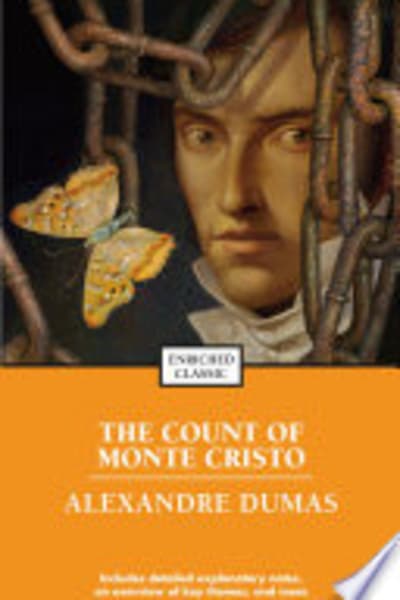
The Count of Monte Cristo — Book Summary & Review
Last updated:
Public domain via Project Gutenberg — free and legal.
The Count of Monte Cristo Summary
The Count of Monte Cristo is structured around the narrator’s promise to show how a single injustice can be converted into a long, engineered revenge plan, and Dumas makes you feel that machinery at work. The story’s backbone is Edmond Dantès’s transformation: after the betrayal that lands him in the Château d’If, he survives fifteen years by clinging to an inner framework—faith that the truth will surface and that patience can be weaponized. When he escapes, the book pivots from prison survival to meticulous preparation, and Dumas leans hard on concrete steps: the acquisition of money, the creation of new identities, and the slow selection of targets. The revenge isn’t a vague “payback”; it’s staged like an operation, with timing, disguises, and leverage. Dantès becomes the kind of man who can wait out a life, then strike when the target’s assumptions are at their weakest.
One of the most satisfying sequences is the way Dumas uses the conspirators’ own social world against them—especially through the early plotting around the three men who engineered his imprisonment: Fernand Mondego, Danglars, and the Abbé Faria’s former confidant, Villefort. The Abbé Faria’s influence also matters less as a sentimental mentor and more as the source of Dantès’s practical intelligence; without that, the rest of the plan would be theater. Still, Dumas doesn’t keep the emotional temperature steady: the book can sprawl into melodrama and secondary arcs that feel like detours when you just want the next move in Dantès’s revenge calculus.
Dumas’s limitation is clear: if you prefer tight realism and moral ambiguity that stays ambiguous, you may find the plotting too orchestrated and the emotional swings too theatrical.
Key Takeaways from The Count of Monte Cristo
-
1
Château d’If captivity: Dumas uses prison survival as the slow-burn engine for a revenge plan, not mere backstory.
-
2
Abbé Faria’s instruction: the escape chapters treat knowledge as ammunition, turning learning into a practical timetable for revenge.
-
3
Edmond Dantès’s new identity: Dantès builds credibility through social performance, letting him move inside elite rooms unseen.
-
4
Danglars, Fernand Mondego, Villefort targeting: each man gets a tailored downfall that matches the specific weakness Dantès observed.
-
5
Revenge as engineering: the plot runs on timing, leverage, and misdirection, making morality feel secondary to execution.
Who Should Read This
Someone who’s currently stuck in a “why did this happen to me?” spiral and wants a story about patience turning into control will likely enjoy this. If you like scheming plots where every outcome has a setup, Dantès’s preparations will scratch that itch.
Who Shouldn't Read This
If you get irritated by long, ornate narration and frequent melodramatic reversals, you’ll find Dumas exhausting. If you want a restrained, modern pace with minimal side plots, you may feel the book is padding the revenge machine.
Editor's Verdict
The single best thing Dumas does is make revenge feel procedural—especially the shift from Château d’If to the escape-and-preparation phase where Dantès’s plan gains its real gears. The real limitation is that the novel’s scale and melodramatic flourishes will test your patience long before the final payoffs. This hits hardest for anyone who’s just been betrayed in a work or relationship situation and wants to see how someone turns humiliation into leverage without immediate closure.
Ready to read The Count of Monte Cristo?
Get your copy on Amazon today.
The Count of Monte Cristo — Frequently Asked Questions
About Alexandre Dumas
Alexandre Dumas (1802–1870) was a French writer born in Villers-Cotterêts. His father was a general in Napoleon’s army, and Dumas later worked in Paris in journalism and theater before turning to historical fiction. He is credible on The Count of Monte Cristo because he wrote extensively about 19th-century French history and society and drew on real historical sources and archives for his plots. Other notable works include The Three Musketeers and Twenty Years After.