The Confessions of St. Augustine — Book Summary & Review
Last updated:
Public domain via Project Gutenberg — free and legal.
The Confessions of St. Augustine Summary
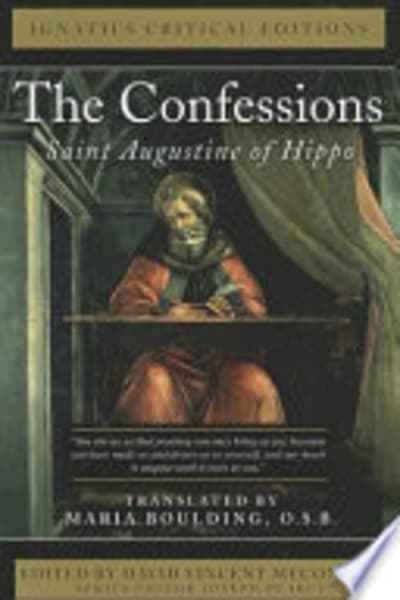
In The Confessions of Saint Augustine, Augustine builds a two-track structure: he recounts his life while repeatedly turning that life into prayer, so each memory becomes an argument about God’s mercy and human self-deception. Early on, Augustine lays down the controlling framework of “confession” as both truth-telling and worship, and he returns to it so often that the book starts to feel less like an autobiography and more like a mind learning how to speak to the divine without lying. In Book VIII, when he discusses memory—how the mind stores images, habits, and impressions—he doesn’t treat memory as psychology; he treats it as evidence that we’re built for something we can’t fully hold. Later, in Book X, his approach to time sharpens the whole enterprise: time isn’t merely a backdrop for his sins, it’s where he locates the mismatch between human measurement and God’s eternal reality. Reading Augustine of Hippo with Sister Maria Boulding’s translation is a particular experience, because Boulding tries to keep the Latin’s precision while preserving Augustine’s poetic pressure; the result is sentences that sound like they’re being spoken in real time, not embalmed in academic prose.
If you come expecting a tidy narrative arc—one clean conversion sequence and then closure—you’ll be frustrated. Augustine keeps circling the same spiritual knots (desire, pride, distraction, grace) without “moving on” the way modern memoirs do. Also, this is not a book that explains doctrines like a textbook; it’s a personal prayer that assumes you’re willing to follow him into questions about will, time, and God even when you don’t share his starting beliefs.
Key Takeaways from The Confessions of St. Augustine
-
1
Confession: Augustine uses “confession” as worship plus self-accusation, turning private memory into public spiritual honesty.
-
2
Memory (Book VIII): He treats memory as a map of the mind, evidence that we’re made to grasp more than we can hold.
-
3
Time (Book X): Augustine argues time is not just measured duration; it’s where human limits collide with God’s eternity.
-
4
Conversion narrative: His life story keeps reappearing as a spiritual problem, not a linear past-tense victory lap.
-
5
Boulding translation style: Boulding aims to preserve 4th-century Latin meaning while keeping Augustine’s poetic heat intact.
Who Should Read This
If you’re stuck replaying old mistakes and wondering why your brain keeps returning to the same sins, Augustine of Hippo will feel uncomfortably accurate. Someone who wants prayer with teeth—memory, time, and desire treated as spiritual evidence—will likely stick with it.
Who Shouldn't Read This
If you want a modern, plot-driven memoir with a clear arc and psychological explanations, this book will feel repetitive and opaque. If you’re allergic to theological argument presented as intimate prayer, Augustine’s method will annoy you rather than reassure you.
Editor's Verdict
The single best thing Augustine of Hippo does is fuse autobiography with metaphysical argument, especially through Book X’s time reflections, where his personal life becomes a critique of how humans measure reality. The real limitation is that the book refuses to “finish” in a modern narrative sense, returning to the same spiritual themes without offering the closure you may crave. This hits hardest for someone who has recently burned out on self-help certainty and wants a voice that admits obsession, failure, and grace in the same breath.
Ready to read The Confessions of St. Augustine?
Get your copy on Amazon today.
The Confessions of St. Augustine — Frequently Asked Questions
About Augustine of Hippo
Augustine of Hippo (354–430 CE) was a North African Christian theologian and bishop of Hippo Regius. Born in Roman North Africa to a Christian mother and a pagan father, he studied rhetoric and became influential through his writings after converting to Christianity. He is credible as the author of The Confessions of St. Augustine, a first-person account of his spiritual life. Other notable works include City of God and On Christian Doctrine.