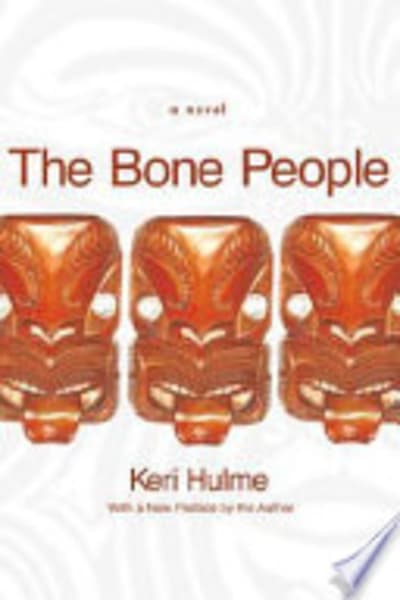
The Bone People — Book Summary & Review
by Keri Hulme
Last updated:
The Bone People Summary
The Bone People opens with the enigmatic Kerewin Holmes, a reclusive artist living in a tower on the New Zealand coast, whose isolation is punctured by the arrival of a mute boy named Simon. Hulme builds a narrative that refuses to settle into a single category, functioning as both mystery and a sharp examination of cultural fault lines, especially between Maori and European New Zealanders. In the chapter titled “The Pain of Cleaving,” the focus sharpens on the violent and tender dynamics that form among Kerewin, Simon, and his foster father Joe. Hulme’s prose is steeped in Maori spirituality, producing a haunting atmosphere that feels immersive rather than decorative. Still, the novel’s nonlinear structure and symbolism-heavy approach will test readers who want a straight line of action. If you came for a conventional love story or a clean mystery, the book’s layered construction and spiritual preoccupations will likely sour the experience.
Key Takeaways from The Bone People
-
1
Kerewin's Tower: Represents isolation and the self-imposed barriers Kerewin builds around her life, both physically and emotionally.
-
2
Silent Communication: Simon's muteness challenges traditional communication, emphasizing non-verbal cues and emotional understanding.
-
3
Maori Spirituality: Infuses the narrative with a deep sense of place and cultural identity, influencing characters' actions and beliefs.
-
4
The Spiral: Symbolizes the cyclical nature of healing and destruction in relationships, mirroring Maori symbols of growth and change.
-
5
The Sea's Call: Acts as a metaphor for the unknown and the subconscious, pulling characters towards introspection and revelation.
Who Should Read This
Someone who is deeply interested in Maori culture and spirituality will find this book a rich tapestry of insights. If you are drawn to stories that challenge conventional narratives and embrace complex character studies, this is for you.
Who Shouldn't Read This
If you prefer linear storytelling without heavy symbolic content, this book may feel unnecessarily convoluted. Readers looking for a fast-paced, action-driven plot will likely be disappointed by its introspective nature.
Editor's Verdict
The Bone People's most striking feature is its vivid portrayal of Maori spirituality, particularly in the chapter 'The Pain of Cleaving.' Its nonlinear storytelling and dense symbolism can be off-putting for those seeking straightforward narratives. This book hits hardest for someone exploring cultural identity or grappling with the complexity of human relationships.
Ready to read The Bone People?
Get your copy on Amazon today.
The Bone People — Frequently Asked Questions
About Keri Hulme
Keri Hulme (1947-2021) was a New Zealand author best known for her novel "The Bone People," which won the Booker Prize in 1985. Born in Christchurch, she was of Māori, Scottish, and English descent, which influenced her writing. Hulme's background in anthropology and her deep connection to Māori culture lent authenticity to her work. Besides "The Bone People," she authored "Te Kaihau / The Windeater," a collection of short stories, and "Stonefish," another collection of stories.