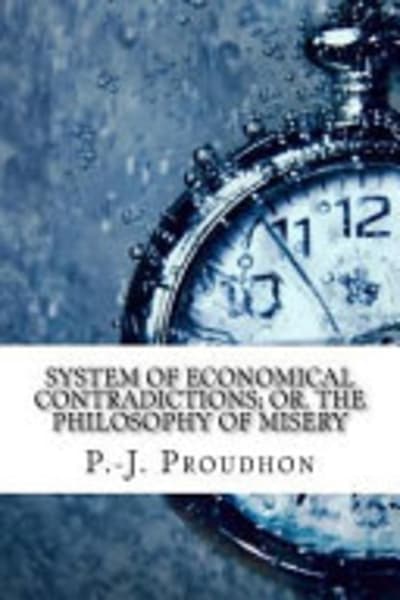
System of Economical Contradictions; Or, The Philosophy of Misery — Book Summary & Review
by P.-J. (Pierre-Joseph) Proudhon
Last updated:
Public domain via Project Gutenberg — free and legal.
System of Economical Contradictions; Or, The Philosophy of Misery Summary
In System of Economical Contradictions, Proudhon builds a recurring framework he calls “contradictions” between economic forms and the misery they produce, then tests that framework through a series of tightly reasoned sections. The book’s core move is to treat poverty not as an accident or a moral failing, but as something that economics generates while pretending it’s distributing freely. Proudhon keeps returning to the idea that “economic” categories—exchange, property, value, competition—claim neutrality while producing systematic degradation for ordinary people. He argues that when you follow these categories to their logical end, you find they require coercion, manipulation, and unequal power to keep functioning.
One concrete example (and it’s the kind of example that will either click or irritate you) is his treatment of property as a practical contradiction: it’s defended as a guarantee of freedom, yet it operates as a mechanism that blocks access, concentrates control, and turns dependence into a norm. Proudhon doesn’t stop at description; he keeps pressing for an internal logic, showing how the same institution that claims to reward labor ends up rewarding privilege. Another repeated target is exchange, which he frames as both the promise of mutual benefit and the engine of unequal outcomes—because the “free” movement of goods depends on prior conditions people don’t choose. If you’ve ever wondered why wage work can feel like a trap that still gets called voluntary, Proudhon’s machinery will feel uncomfortably familiar.
The limitation: this isn’t a narrative or a policy manual with step-by-step reforms; it’s an argumentative, often abrasive philosophical attack that will frustrate readers who want empirical data, modern examples, or a clean ending. Also, the “fiction” label doesn’t mean character-driven storytelling—expect a thinker’s system, not plot.
Key Takeaways from System of Economical Contradictions; Or, The Philosophy of Misery
-
1
Contradictions: Proudhon treats economic systems as internally inconsistent, where their stated goals require misery to persist.
-
2
Property as Mechanism: ownership functions less like freedom and more like an access filter that breeds dependency and unequal power.
-
3
Exchange and Unequal Outcomes: “free exchange” relies on prior conditions, so the results skew toward those who start ahead.
-
4
Value Logic: Proudhon pushes value beyond pricing, arguing it hides coercive social relations beneath neutral language.
-
5
Philosophy of Misery: misery is not an exception; it’s an output of how economic categories are structured and enforced.
Who Should Read This
If you’re stuck in the frustration of seeing “fairness” talk while your lived reality keeps feeling rigged, Proudhon gives you a framework to argue back. Someone who likes dense, confrontational political philosophy and wants to trace how institutions generate suffering will probably stick with it.
Who Shouldn't Read This
If you want a readable, modernized economics primer with examples from today’s world, Proudhon’s style will feel heavy and needlessly combative. If you need a clear reform blueprint or a storyline, you’ll be disappointed by how little this book cares about narrative satisfaction.
Editor's Verdict
The best thing Proudhon does is keep forcing economic concepts to “answer” for the misery they produce, especially in his treatment of property as a contradiction between freedom and exclusion. The real limitation is that the book offers argument over evidence and refuses to become a practical guide, which makes it frustrating for readers who want data or actionable steps. This hits hardest for anyone early in their political awakening—right before they start reading economics as if it were value-neutral.
Ready to read System of Economical Contradictions; Or, The Philosophy of Misery?
Get your copy on Amazon today.
System of Economical Contradictions; Or, The Philosophy of Misery — Frequently Asked Questions
About P.-J. (Pierre-Joseph) Proudhon
P.-J. (Pierre-Joseph) Proudhon (1809–1865) was a French political thinker and writer. Born in Besançon to a working-class family, he worked as a printer and self-educated, later becoming known for radical critiques of property and political economy. He is credible on poverty and economic contradiction because he analyzed how market and state institutions produce inequality and “misery.” Notable works include What Is Property? (1840) and The Philosophy of Progress (1853).