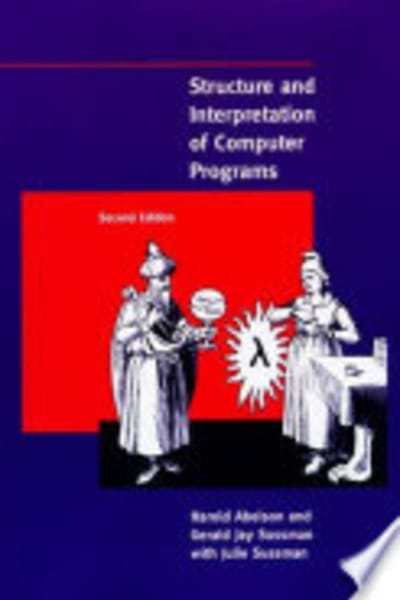
Structure and Interpretation of Computer Programs — Book Summary & Review
Last updated:
Structure and Interpretation of Computer Programs Summary
Abelson and Sussman introduce the concept of “metalinguistic abstraction” in their book, a polished way of describing the creation of new languages to tackle specific problems. The structure runs through five comprehensive chapters, each building on the previous one to lay out the principles of programming using Scheme, a dialect of Lisp. Chapter 3, “Modularity, Objects, and State,” is especially focused on data abstraction and the real payoff of modularity in code. Their careful treatment of recursion, higher-order procedures, and the environment model of evaluation reflects an academic rigor that rewards commitment. Still, if you want a breezy, easy entry into programming, the density and complexity of the text will likely feel like punishment rather than education.
Key Takeaways from Structure and Interpretation of Computer Programs
-
1
Metalinguistic Abstraction: Develop new languages to better solve specific problems, enhancing flexibility and problem-solving in programming.
-
2
Environment Model of Evaluation: Understand how expressions are evaluated in programming languages, crucial for mastering Scheme and similar languages.
-
3
Data Abstraction: Learn to separate the use of data from its representation, promoting modularity and simplifying system design.
-
4
Higher-Order Procedures: Use procedures that take other procedures as arguments or return them as results, expanding programming capabilities.
-
5
Recursion Techniques: Master the art of defining a function in terms of itself, a fundamental concept in computer programming.
Who Should Read This
Someone who is diving deep into computer science studies and wants a thorough understanding of programming theory. If you're tackling a course on functional programming or need a comprehensive guide to Lisp, this book is for you.
Who Shouldn't Read This
If you are new to programming and looking for a simple guide to get started, this book will likely overwhelm you. Its academic tone and complex examples are not suited for casual readers or those seeking quick, practical coding tips.
Editor's Verdict
The book excels in its treatment of the environment model of evaluation, offering clarity on a complex topic. However, it demands patience and prior knowledge, leaving beginners potentially lost. For computer science students or anyone preparing for advanced programming courses, this book can be an excellent resource.
Ready to read Structure and Interpretation of Computer Programs?
Get your copy on Amazon today.
Structure and Interpretation of Computer Programs — Frequently Asked Questions
About Abelson & Sussman
Harold Abelson and Gerald Jay Sussman are prominent computer scientists known for their contributions to programming education. Abelson is a professor at MIT's Electrical Engineering and Computer Science department, while Sussman is the Panasonic Professor of Electrical Engineering at MIT. Their credibility stems from their pioneering work in computer science education and research. Besides "Structure and Interpretation of Computer Programs," Sussman co-authored "Software Design for Flexibility," and Abelson co-authored "Turtle Geometry."