RubyMotion iOS Develoment Essentials — Book Summary & Review
by Akshat Paul
Last updated:
RubyMotion iOS Develoment Essentials Summary
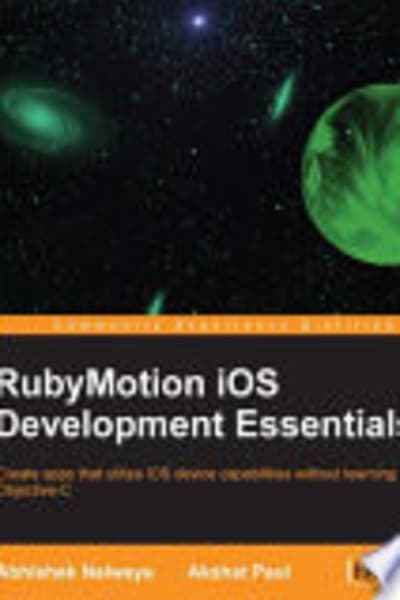
RubyMotion iOS Development Essentials is organized around a very practical escalation: Akshat Paul walks you from installing RubyMotion to building a running iOS app that uses real device features, then to testing and App Store submission. Paul’s repeated through-line is “write Ruby, ship native,” and you feel that in the way he pairs RubyMotion syntax with the underlying iOS SDK classes—he even frames it as an alternative to Objective-C complexity, not a vague abstraction. A concrete example is the chapter work around device capabilities like the camera, geolocation, and multitouch/gestures; the book keeps pointing you back to “use the iOS device capabilities such as GPS, camera, multitouch” by building screens that actually call them. Another section focus is UI-building with the Xcode interface builder workflow, so you’re not stuck hand-coding every view. Paul also gets specific about offline data storage via Core Data, which matters because many beginner guides stop at “hello world” or networking.
Where Paul really earns his keep is the pragmatic tooling layer: he covers RubyMotion gems, shows how to extend projects, and then shifts to testing so you’re not launching blind. If you’re following along, you’ll also see the address book and WebView angle used to justify why RubyMotion still needs the iOS SDK. The honest limitation: this book is heavy on “how to do it in RubyMotion” but light on the deeper why behind architectural decisions, performance tradeoffs, or long-term maintenance strategy, so advanced iOS engineers may find it too introductory and a bit dated for modern toolchains.
Key Takeaways from RubyMotion iOS Develoment Essentials
-
1
RubyMotion toolchain: A workflow for writing Ruby that compiles to native iOS apps, aimed at speeding up real development.
-
2
Objective-C syntax comparison: Paul maps RubyMotion constructs to their Objective-C equivalents so you can translate mental models quickly.
-
3
Xcode interface builder: You can design UI in Xcode while still driving behavior from RubyMotion, reducing UI boilerplate.
-
4
RubyMotion gems: Extend apps with add-on packages; the book treats gems as a practical way to ship features faster.
-
5
Core Data offline storage: The Core Data section shows how to persist data for offline use instead of relying on in-memory demos.
Who Should Read This
If you’re stuck writing Objective-C and feel every iOS tutorial turns into setup pain and boilerplate, this is for you. Someone who wants to build a working app that uses device features (camera, GPS, gestures) and then test it before App Store submission will benefit.
Who Shouldn't Read This
If you already know iOS well and want a modern, architecture-first guide with performance and maintainability tradeoffs, Paul’s scope will feel thin. If you need up-to-the-minute RubyMotion ecosystem guidance, this 2013-era book may frustrate you with outdated assumptions.
Editor's Verdict
RubyMotion iOS Development Essentials is at its best when Paul forces you through a complete beginner-to-launch loop: install RubyMotion, build UI with Xcode interface builder, wire device capabilities, then add testing and App Store submission steps. The real limitation is that it stays mostly procedural and doesn’t give much depth on “why” decisions, so it won’t satisfy readers looking for serious engineering judgment. This hits hardest for a beginner about to start their first real iOS project and dreading the Objective-C learning curve, because Paul’s side-by-side framing reduces the fear fast.
Ready to read RubyMotion iOS Develoment Essentials?
Get your copy on Amazon today.
RubyMotion iOS Develoment Essentials — Frequently Asked Questions
About Akshat Paul
Akshat Paul is the author of RubyMotion iOS Development Essentials. He is a software developer focused on iOS development using RubyMotion, with hands-on experience building iOS applications in Ruby. His credibility comes from writing practical, implementation-oriented guidance for RubyMotion developers, covering core iOS development workflows and patterns. Other notable works by Akshat Paul are not specified in the provided information.