Sophie's World — Book Summary & Review
Last updated:
Sophie's World Summary
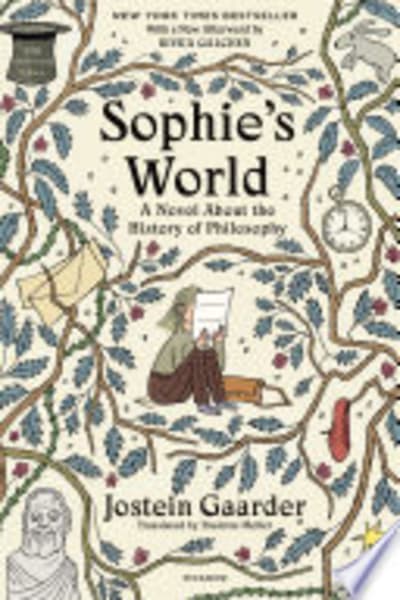
Sophie's World kicks off with two seemingly simple questions: 'Who are you?' and 'Where does the world come from?' which drive Sophie Amundsen into a philosophical whirlwind. Gaarder structures the novel through a series of letters that transform into a philosophy course, covering thinkers from Socrates to Sartre. The chapter 'Berkeley' stands out as Sophie grapples with the idea that reality might be a mental construct, challenging her perception of the world. Gaarder cleverly intertwines these lessons with a mysterious subplot involving a girl named Hilde, whose mail Sophie keeps receiving. However, the book does not delve deeply into Eastern philosophies, focusing almost exclusively on Western thought, which might frustrate readers looking for a more global perspective. Overall, Gaarder manages to make complex philosophical concepts accessible, albeit with a Eurocentric lens, making the book both educational and engaging for those new to philosophy.
Key Takeaways from Sophie's World
-
1
The Philosophical Garden: Gaarder uses this metaphor to illustrate how philosophy requires cultivation of different ideas to grow understanding.
-
2
The Major's Cabin: A pivotal location in the book symbolizing the intersection of reality and imagination where Sophie confronts her existential questions.
-
3
The Mirror: A recurring motif in the book representing self-reflection and the duality of human nature as Sophie explores her identity.
-
4
Berkeley's Idealism: Explored through Sophie's lessons, it challenges the notion of objective reality by suggesting that existence is dependent on perception.
-
5
Hilde's World: A narrative twist where Sophie discovers her life is part of a book read by another girl, blurring the lines of fiction and reality.
Who Should Read This
If you're someone who's curious about Western philosophy but finds traditional texts daunting, this book offers an engaging entry point. Someone who enjoys unraveling mysteries and puzzles within a narrative will find Sophie’s World particularly rewarding.
Who Shouldn't Read This
If you're seeking a comprehensive exploration of global philosophical traditions, this book's Western focus will disappoint. Also, readers who prefer straightforward narratives might find the layered plot and philosophical digressions frustrating.
Editor's Verdict
Gaarder's ability to weave philosophical lessons into an engaging narrative, particularly through 'Hilde’s World', is truly impressive. However, the book's narrow focus on Western philosophy limits its appeal for those interested in a broader scope. Anyone in the early stages of their philosophical journey or grappling with existential questions will find this book particularly resonant.
Ready to read Sophie's World?
Get your copy on Amazon today.
Sophie's World — Frequently Asked Questions
About Jostein Gaarder
Jostein Gaarder, born August 8, 1952, in Oslo, Norway, is a renowned author and former philosophy teacher. He gained international acclaim with his novel "Sophie's World" (1991), which explores the history of philosophy through a fictional narrative. Gaarder's background in philosophy and education lends credibility to his writing on philosophical subjects. Other notable works include "The Solitaire Mystery" (1990) and "The Orange Girl" (2003), which also incorporate philosophical themes.