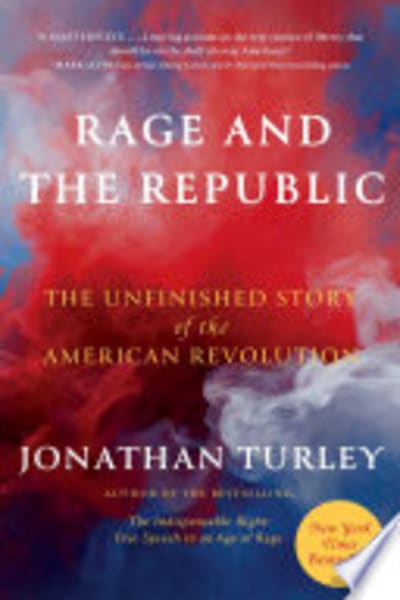
Rage and the Republic — Book Summary & Review
Last updated:
Rage and the Republic Summary
Rage and the Republic is organized around Jonathan Turley’s argument that political violence in the early United States wasn’t a freak accident but a recurring civic language—one he traces through the rhetoric, institutions, and moral justifications that made “rage” feel legitimate. Turley keeps returning to a tight framework: when republican self-government is threatened, he claims, elites and ordinary actors alike reach for emotionally charged justification, then retrofit it as patriotism, law, and duty. One of the book’s most concrete moves is how Turley treats “the republic” as something people fight over in words before they fight over it in bodies, so that speeches, pamphlets, and courtroom performances become part of the same system that later produces coercion.
In the chapters that focus on revolutionary and post-revolutionary conflict, Turley repeatedly contrasts official restraint with unofficial escalation, showing how “order” rhetoric can coexist with vigilante or factional action. He also leans on the idea that outrage is not merely a feeling but a political instrument—an engine that converts grievance into collective permission. If you’ve ever wondered why outrage seems to travel faster than facts, Turley’s answer is structural: the republic’s public sphere rewards moral certainty, and moral certainty supplies the fuel for escalation.
A limitation: Rage and the Republic doesn’t read like a clean, chronological narrative, and it can frustrate readers who want a single sustained case study with a neat ending. It’s also heavy on political interpretation rather than on step-by-step “how” lessons for modern readers who crave direct takeaways.
Key Takeaways from Rage and the Republic
-
1
Republic-as-language: Turley treats rhetoric as a governing technology, where speeches and pamphlets help authorize later coercion.
-
2
Rage as political instrument: Outrage becomes permission—grievance is converted into collective action through moral certainty.
-
3
Official restraint vs factional escalation: He shows how “order” talk can sit beside vigilante behavior without contradiction.
-
4
Public sphere rewards certainty: Turley argues that institutions amplify confident moral claims, crowding out careful ambiguity.
-
5
Republicary legitimacy through performance: Courtroom and civic displays function as part of the same ecosystem as street conflict.
Who Should Read This
Someone who’s trying to make sense of how democratic societies slide from protest into permission for force will get a lot out of Turley’s framework. If you’re stuck watching modern outrage harden into ideology and want a historical explanation that isn’t moralizing, Turley is worth your attention.
Who Shouldn't Read This
If you want a straightforward timeline with clearly labeled episodes and a tidy conclusion, Turley’s interpretive, thematically organized approach will frustrate you. If you came for modern policy prescriptions or practical “what to do next” guidance, Rage and the Republic will feel like it withholds what you’re looking for.
Editor's Verdict
Rage and the Republic’s best strength is Turley’s insistence that political violence grows out of civic rhetoric and institutional reward systems, not from random bad actors—his recurring contrast between “official restraint” and “factional escalation” lands hard. The real limitation is that the book is more interpretive than narratively structured, so readers who crave a clean chronology or a single case study may feel jerked around. If you’re a history-minded reader who’s been arguing online and then regretting the certainty your side demanded, this book hits hardest in that moment right after you realize how quickly outrage can feel like duty.
Ready to read Rage and the Republic?
Get your copy on Amazon today.
Rage and the Republic — Frequently Asked Questions
About Jonathan Turley
Jonathan R. Turley is an American legal scholar and professor. He has served as a professor at the University of Maryland Francis King Carey School of Law and previously at George Washington University. Turley is credible on the subject of political violence and constitutional history because his academic work focuses on law, government, and the courts, and he writes extensively about the U.S. legal system. His notable works include The Second Civil War and The Death Penalty.