Hemingway — Book Summary & Review
Last updated:
Hemingway Summary
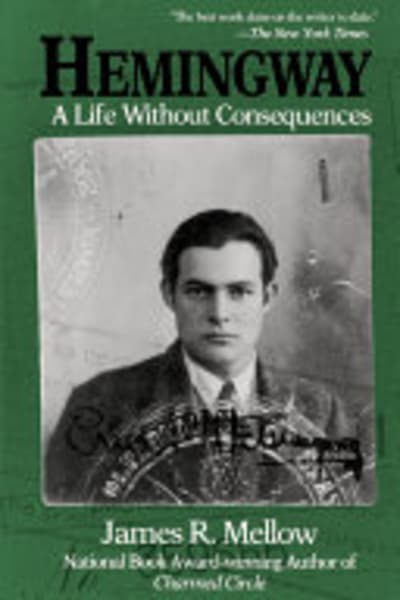
In James R. Mellow’s Hemingway, the author organizes the biography around the tension between Ernest Hemingway’s public persona and what Mellow calls the writer’s “private life” machinery—how the same man who cultivated toughness also engineered emotional control. Mellow’s structure moves through major career beats, but he keeps snapping readers back to the question of motive: what did Hemingway think he was doing when he chose war reporting, bullfighting, big-game hunting, and the famously stripped-down style? One concrete example comes early from Mellow’s attention to Hemingway’s early journalistic formation and the way it trained him to treat experience like material for revision, not memory for comfort. Later, Mellow returns to the well-known chronology of the Spanish Civil War and World War II coverage, then complicates it by tracking how Hemingway’s relationships and jealousies shaped what he emphasized and what he minimized. Mellow also leans on the pattern he sees in Hemingway’s self-mythmaking—how each “new” persona (sportsman, correspondent, master craftsman) functions like a tool for managing fear. A specific through-line is Mellow’s treatment of the “iceberg” style: he doesn’t just repeat the metaphor; he shows how Hemingway’s omissions often line up with personal boundaries and self-protection. The book’s strongest chapters are the ones where Mellow juxtaposes letters, reported behavior, and the timing of major works to argue that Hemingway’s craft was inseparable from his coping strategies. The limitation is blunt: Mellow does not offer a clean, satisfying psychological diagnosis or a definitive “why it all went wrong” answer, and readers who want a tight focus on prose technique or a short, selective biography will feel buried under the breadth.
Key Takeaways from Hemingway
-
1
Private life framework: Mellow treats Hemingway’s emotional management as the engine behind the public myth.
-
2
Iceberg style: omissions function like boundaries, not just an aesthetic; Mellow links gaps to self-protection.
-
3
War correspondent chronology: reporting choices mirror personal needs, shaping what gets foregrounded in the writing.
-
4
Self-mythmaking pattern: each persona is a tool for control, not a spontaneous evolution of character.
-
5
Letters-and-timing method: Mellow uses correspondence and work dates to argue motive, not merely to recount events.
Who Should Read This
If you’re stuck in the habit of reading Hemingway as pure style and want to know what personal forces make that style possible, this book will land. Someone who’s recently hit the point where “genius biography” feels hollow will appreciate Mellow’s insistence on motive and timing.
Who Shouldn't Read This
If you only want a streamlined account of Hemingway’s major works and craft lessons, Mellow’s wide-ranging focus will frustrate you. If you’re allergic to heavy reliance on relationship history and psychological inference, this biography will feel too crowded and speculative.
Editor's Verdict
Mellow’s best move is his persistent linkage of the “iceberg” idea to Hemingway’s emotional boundaries, especially when he tracks how omissions and revisions line up with lived pressures. The limitation is that the book refuses to deliver a single, definitive psychological explanation for Hemingway’s private collapse. This will hit hardest for anyone who reads Hemingway mid-career while questioning whether their own self-image is doing as much work as their skills.
Ready to read Hemingway?
Get your copy on Amazon today.
Hemingway — Frequently Asked Questions
About James R. Mellow
James R. Mellow (1927–2014) was an American literary biographer and critic. He earned his education in the United States and worked as a writer and editor, focusing on major twentieth-century authors. He is credible on Ernest Hemingway because he produced extensive archival-based scholarship and wrote the definitive biography of Hemingway. His other notable works include Charmed Circle: The Biography of John Cheever and Inventing the Past: Essays on Literature and History.