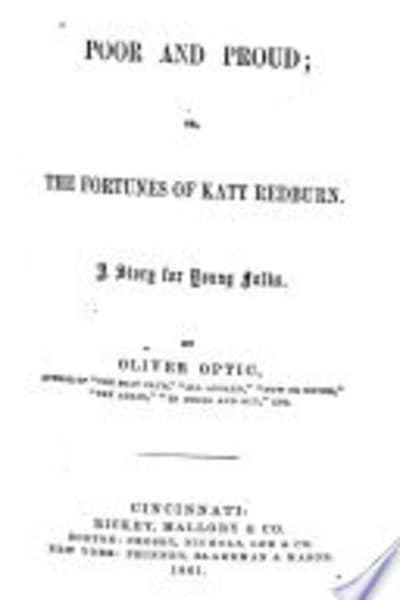
Poor and Proud; Or, The Fortunes of Katy Redburn: A Story for Young Folks — Book Summary & Review
by Oliver Optic
Last updated:
Public domain via Project Gutenberg — free and legal.
Poor and Proud; Or, The Fortunes of Katy Redburn: A Story for Young Folks Summary
In Poor and Proud, Oliver Optic builds the plot around a very plain, almost programmatic contrast: Katy Redburn’s “pride” in doing right by her family versus the humiliations poverty keeps throwing in her way. The story is structured as a run of escalating trials—work found, work lost, money promised, money stolen—so you can watch Katy’s character get tested in small, specific ways rather than in one dramatic courtroom moment. Optic’s favorite technique is to make the hardship feel concrete: the cost of decent clothes, the sting of being turned away, the way a single bad decision can ripple through a household.
One of the most telling stretches comes when Katy is pushed into labor that’s “proper” in the eyes of adults but punishing in practice. Another recurring situation is Optic’s insistence on reputation: Katy can be honest and still get treated like she’s trouble because she’s poor. Optic also gives you a consistent moral measuring stick—your choices matter, but so does how society decides who deserves patience. The book keeps returning to that tension: Katy tries to behave with dignity, yet the world keeps charging her extra for it.
The honest limitation is that this is sentimental, older-school moral fiction. It won’t satisfy readers who want psychological ambiguity, modern pacing, or a realistic view of poverty systems. If you’re looking for social critique with teeth, Optic mostly stays in the lane of character-and-consequence lessons, not structural analysis.
Even so, Optic earns its ending by letting Katy’s “fortunes” shift in ways that feel earned, not magically handed over. You finish with a clearer sense of what pride should mean when you’re broke—and how often adults confuse “need” with “deserving.”
Key Takeaways from Poor and Proud; Or, The Fortunes of Katy Redburn: A Story for Young Folks
-
1
Katy Redburn’s “pride” frames dignity as behavior, not wealth, showing how she keeps her standards even when others deny her respect.
-
2
Optic’s reputation test treats poverty as a social label, where being honest doesn’t automatically erase suspicion or prejudice.
-
3
Escalating labor trials mean work is moral training in the story, with each job changing Katy’s choices and the risks she faces.
-
4
Consequence-based plotting makes small decisions matter, so readers see how one setback can multiply across family stability.
-
5
Optic’s moral measuring stick separates character from outcomes, insisting kindness and integrity still count when life won’t cooperate.
Who Should Read This
If you’re dealing with the daily grind where people judge you for circumstances you can’t fully control, this book gives Katy Redburn as a steady companion. Someone who’s trying to keep dignity while juggling family responsibilities will recognize the emotional math Optic keeps stressing.
Who Shouldn't Read This
If you want modern realism about poverty’s systems—housing, labor policy, and institutional cruelty—this will feel too focused on individual character lessons. If you dislike sentimental moral fiction with predictable moral rhythms, Optic’s style will likely frustrate you.
Editor's Verdict
The single best thing this book does is make Optic’s reputation-and-dignity conflict feel immediate through Katy Redburn’s repeated work-and-dismissal cycles. The real limitation is that it stays at the level of personal virtue and consequence, offering little structural critique of poverty. This hits hardest for readers who are mid-stress with responsibility at home and need a story where integrity survives setbacks without pretending hardship is fair.
Ready to read Poor and Proud; Or, The Fortunes of Katy Redburn: A Story for Young Folks?
Get your copy on Amazon today.
Poor and Proud; Or, The Fortunes of Katy Redburn: A Story for Young Folks — Frequently Asked Questions
About Oliver Optic
Oliver Optic (pen name of George William Curtis; 1822–1872) was an American writer of juvenile and popular fiction. He worked as a journalist and editor, and his books often focused on youth, character, and everyday moral lessons. He is credible on this topic because Poor and Proud presents the hardships and responsibilities of a young girl in a realistic, instructional style typical of his work. Other notable works include The Young Pilot and The Soldier Boy.