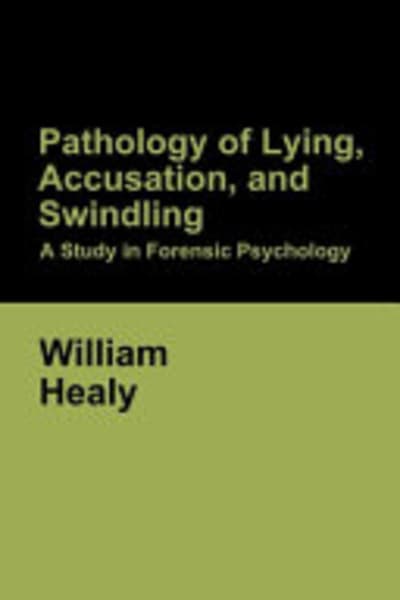
Pathology of Lying, Accusation, and Swindling: A Study in Forensic Psychology — Book Summary & Review
Last updated:
Public domain via Project Gutenberg — free and legal.
Pathology of Lying, Accusation, and Swindling: A Study in Forensic Psychology Summary
William Healy structures Pathology of Lying, Accusation, and Swindling around forensic psychology—how clinicians and courts should interpret deception, false accusations, and habitual swindling as patterns rather than mere “bad character.” Healy keeps returning to a practical framework: the liar’s behavior has a measurable logic, and the job of the investigator is to separate impulsive fabrication, self-protective lying, and more entrenched pathological deception. One of the clearest places this shows up is in the opening portion where Healy treats accusation as a behavior with motives, not simply a moral failure; he argues that false accusation often follows recognizable emotional and social pressures, including the need to shift blame or control the narrative. Healy’s case-style discussion also emphasizes the forensic value of consistency: when someone’s story changes, the pattern of those changes can be more diagnostic than any single statement.
A concrete example Healy leans on is the way a “swindler” can maintain a coherent persona while still exhibiting telltale inconsistencies across time—details that don’t add up, stories that conveniently adjust, and a tendency to recruit others into the deception. Healy contrasts that with other forms of lying that are less about strategy and more about impulse or circumstance, and he repeatedly nudges the reader toward differential interpretation. In other words, Healy is less interested in catching liars than in classifying the type of lying so you don’t apply one-size-fits-all assumptions.
The limitation is real: this book doesn’t offer a modern, step-by-step protocol for courtroom use, and its examples feel rooted in early-20th-century assumptions about mental life. If you want updated neuroscience, validated lie-detection methods, or contemporary legal procedure, Healy will leave you frustrated rather than reassured. Still, if you’re trying to understand why accusation and swindling can behave like “systems,” Healy’s Pathology is unusually specific for its era.
Key Takeaways from Pathology of Lying, Accusation, and Swindling: A Study in Forensic Psychology
-
1
Forensic psychology framework: Healy treats deception as classifiable behavior patterns, not a single moral category.
-
2
Accusation motive analysis: false accusations often track emotional need and social pressure, not random maliciousness.
-
3
Consistency as evidence: the pattern of story changes matters more than any one statement in isolation.
-
4
Swindler persona coherence: long-term deception can still show diagnostic inconsistencies across time and retellings.
-
5
Differential interpretation: Healy urges separating impulsive lying from strategic pathological deception before judging intent.
Who Should Read This
If you’ve ever had to untangle a messy dispute where accusations kept morphing, this will help you think in patterns instead of gut reactions. Someone who works in investigation, counseling, or law-adjacent roles and wants a classification-minded way to read deception should start here.
Who Shouldn't Read This
If you came for a modern lie-detection guide with validated techniques, Healy’s early-psychology framing will feel outdated and frustrating. If you need a clearly signposted structure with chapter-by-chapter “how to” instructions, you may find the case-based approach hard to translate into action.
Editor's Verdict
Healy’s best contribution is the way he treats accusation as behavior with motives and interpretable patterns, especially in the early sections focused on false accusation. The limitation is that the book lacks a modern, courtroom-ready methodology and leans heavily on period-specific assumptions about mental life. This hits hardest for anyone dealing with ongoing interpersonal conflict where narratives shift over time and you need a framework before you assign blame.
Ready to read Pathology of Lying, Accusation, and Swindling: A Study in Forensic Psychology?
Get your copy on Amazon today.
Pathology of Lying, Accusation, and Swindling: A Study in Forensic Psychology — Frequently Asked Questions
About William Healy
William Healy (1869–1963) was an American psychiatrist and child psychologist associated with the Judge Baker Foundation in Boston. He became known for applying clinical observation and case study methods to antisocial behavior, including deception, false accusations, and fraud. His credibility on these topics comes from his extensive forensic and psychological work with children and youth in legal and institutional settings. Other notable works include The Individual Delinquent (with Augusta F. Healy) and The Family (with Augusta F. Healy).