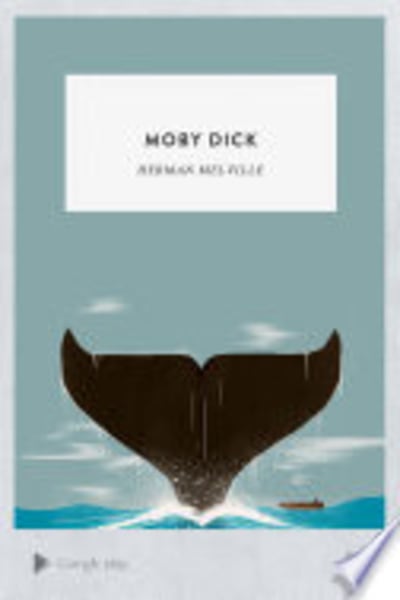
Moby Dick — Book Summary & Review
Last updated:
Public domain via Project Gutenberg — free and legal.
Moby Dick Summary
In Moby-Dick, Melville builds the hunt around Ahab’s obsession and the Pequod’s commercial mission being “perverted” into vengeance, then keeps widening the frame until you’re reading a metaphysical argument wearing a whaling plot as a disguise. The novel’s structure is part voyage log, part sermon, and part furious lab report: after the early setup of the voyage and the crew, Melville slows down hard for the encyclopedic whaling chapters, then swings back into drama when Ahab’s will starts overriding everything. One of the book’s clearest engines is the recurring contrast between the sea as labor and the sea as fate—especially when Ahab treats the white whale as a “symbol” of “some unknown but still reasoning thing,” not as an animal. Melville’s chapter on “The Whiteness of the Whale” is where the book’s argument sharpens: whiteness becomes a projection screen for dread and meaning, and you can feel Melville trying to make you confront the psychology of fixation, not just the spectacle of killing. Meanwhile, the novel’s obsession with naming and categorizing—gear, techniques, anatomy, nautical lore—creates a cruel irony: the more the book teaches you how to hunt, the more it implies that hunting is the excuse for a deeper compulsion. I finished Moby-Dick thinking Melville wanted to show that an individual grievance can metastasize into cosmic defiance, and that the sea doesn’t care, even when we do. The honest limitation: if you want a tight, steadily escalating adventure with minimal digressions, Melville will frustrate you—some chapters read like research notes you didn’t ask for, and the metaphysical monologues can feel repetitive even when they’re brilliant.
Key Takeaways from Moby Dick
-
1
Ahab’s obsession turns whaling labor into vengeance, so every storm and setback becomes fuel for his private theology.
-
2
The “whaling” chapters function like technical argument, making the hunt feel real while exposing the hunt’s spiritual emptiness.
-
3
“The Whiteness of the Whale” reframes color as projection, showing how meaning gets manufactured inside fear.
-
4
The Pequod’s voyage mirrors a closed system, where crew dynamics can’t escape Ahab’s gravity for long.
-
5
Moby-Dick’s repetition of naming and classification mocks human control, even as it teaches you the machinery of pursuit.
Who Should Read This
Someone who’s sick of modern stories that rush to plot payoff and wants a novel that argues with you—loudly—will likely get something out of Moby-Dick. If you’re in the middle of a fixation you can’t rationalize away—work, grief, an old injury—Ahab’s spiral will land with uncomfortable clarity.
Who Shouldn't Read This
If you need clean pacing and quick chapter-to-chapter momentum, you’ll bounce off Melville’s long technical and philosophical detours. If you’re expecting a straightforward “sea adventure,” Moby-Dick keeps interrupting action with symbolism, lectures, and repetition that can feel like punishment.
Editor's Verdict
Moby-Dick’s best move is “The Whiteness of the Whale,” where Melville turns a hunt into a study of projection and fear, and you can’t unsee the psychology after. The real limitation is the book’s heavy digressions and rhetorical repetition, which will feel like wasted time to readers craving constant narrative propulsion. This hits hardest for anyone who’s just watched a fixation take over their thinking—anyone mid-career, mid-grief, or mid-obsession—because Ahab’s logic sounds eerily persuasive in your own head.
Ready to read Moby Dick?
Get your copy on Amazon today.
Moby Dick — Frequently Asked Questions
About Herman Melville
Herman Melville (1819–1891) was an American writer born in New York City. He worked as a sailor and traveled extensively, experiences that informed his maritime knowledge and firsthand understanding of whaling culture. This makes him credible on the subject of Moby-Dick, which draws on real whaling practices and sea life. He wrote Moby-Dick (1851) and also notable works such as Typee (1846) and Billy Budd (posthumously published in 1924).