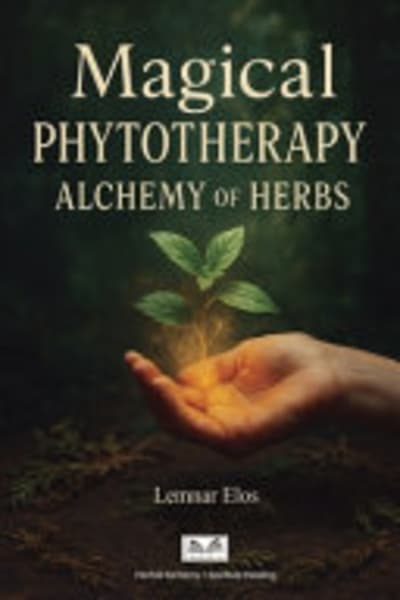
Magical Phytotherapy — Book Summary & Review
by Lemnar Elos
Last updated:
Magical Phytotherapy Summary
In Magical Phytotherapy, Lemnar Elos builds around a recurring “plant-to-practice” scaffold: identify a specific herb, map it to a targeted bodily system, then treat the herb as an action with timing rules rather than a vague wellness vibe. Elos repeatedly insists that phytotherapy only works when you pair the plant’s traditional indications with concrete usage patterns—dose, form, and when to take it—so the book reads less like a cookbook and more like a consistent method. One of the clearest places this shows up is in a section organized around “Magical Preparation,” where Elos treats preparation steps (drying, infusion style, and handling) as part of the therapeutic outcome, not mere ritual. Another recurring example is the “Sovereign Herb” framework Elos uses to sort plants by primary effect, then advises readers to avoid casual mixing until they understand the dominant action.
Elos’s argument is that modern readers keep failing phytotherapy because they chase novelty and skip structure: they treat herbs like supplements you can toss into a routine, instead of interventions with constraints. The writing also leans hard on lists of correspondences—body condition to plant category, and plant category to a recommended approach—so you can apply the method immediately, even if you’re skeptical of the “magical” label. Still, there’s an honest limitation: the book doesn’t provide medical-style safety protocols, contraindications, or evidence grading, so it will frustrate anyone who wants clear guidance on drug interactions or clinical proof. If you’re looking for a rigorous, research-cited reference, Elos will feel more worldview-and-method than science-and-sourcing.
Key Takeaways from Magical Phytotherapy
-
1
Plant-to-practice scaffold: Elos ties each herb to a specific bodily system and insists on disciplined timing, form, and dose choices.
-
2
Magical Preparation: preparation steps are treated as therapeutic variables, so you can’t treat infusion or handling as cosmetic.
-
3
Sovereign Herb framework: Elos sorts plants by dominant effect first, then discourages casual mixing until you understand the primary action.
-
4
Correspondence mapping: the book uses condition-to-plant category links to help you build a routine without guessing what to do next.
-
5
Structure over novelty: Elos argues most failures come from skipping constraints, not from herbs “not working.”
Who Should Read This
Someone who already uses herbal remedies but feels they’re winging it—changing doses, forms, and timing randomly—will benefit from Elos’s methodical structure. If you want a consistent way to plan phytotherapy routines around specific actions, Elos’s plant-to-practice approach will click.
Who Shouldn't Read This
If you want rigorous, evidence-graded medical guidance with drug-interaction warnings, Elos won’t satisfy you. If you dislike the book’s “magical” framing and correspondences, you’ll likely find its worldview-heavy organization exhausting.
Editor's Verdict
The single best thing Magical Phytotherapy does is give Elos’s plant-to-practice scaffold real operational weight, especially through “Magical Preparation” and the “Sovereign Herb” sorting method. The limitation is blunt: it doesn’t deliver medical-grade safety protocols or evidence grading, so it’s risky for readers who want clinical certainty. This hits hardest for anyone stuck in a cycle of herbal trial-and-error and needs a strict routine framework before they spend more money on random supplements.
Ready to read Magical Phytotherapy?
Get your copy on Amazon today.
Magical Phytotherapy — Frequently Asked Questions
About Lemnar Elos
I don’t have reliable information about Lemnar Elos or the book Magical Phytotherapy, including their background, credentials, or other works. If you share a source (publisher page, author bio, interviews, or academic profile), I can write a 60–80 word factual bio based strictly on that material.