Lincoln's Gettysburg Address — Book Summary & Review
Last updated:
Public domain via Project Gutenberg — free and legal.
Lincoln's Gettysburg Address Summary
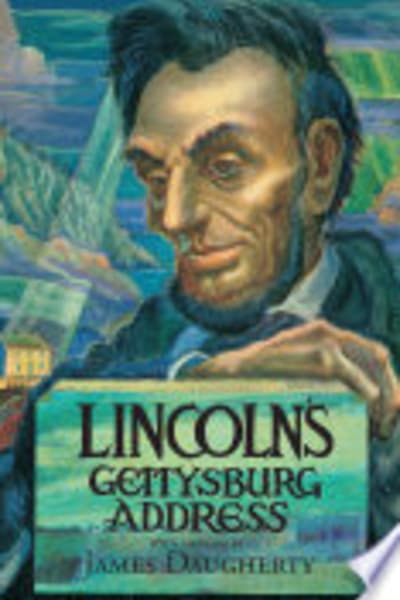
This edition frames Abraham Lincoln’s Gettysburg Address through James Daugherty’s mural-style illustrations, and the new introduction by Gabor S. Boritt sets up why the speech still matters beyond the battlefield. Lincoln’s text arrives clean and plain, but the book’s structure nudges you to read the address as a carefully built argument: first the grim context of sacrifice, then the pivot to national purpose, and finally the famous lines about “a new birth of freedom.” If you’ve only ever heard the Gettysburg Address as a quote collection, this format forces you to sit with the whole thing as one continuous statement, with the visual panels acting like punctuation. Daugherty’s artwork is lush enough to risk sentimentalizing the past, yet it also gives you a way to track the speech’s emotional temperature—mourning at the opening, resolve in the middle, and a kind of moral insistence at the end.
Boritt’s introduction adds the missing scaffolding: he ties the address to Lincoln’s presidency, the political pressure of the moment, and the broader Civil War context, so the speech reads less like a late-career victory lap and more like a strategic act of meaning-making. Lincoln’s choices—especially the repetition of “we” and the insistence that the nation’s purpose depends on how people live afterward—land harder when you’re forced to watch the visuals linger on faces, flags, and ruin. Still, this book isn’t a full scholarly biography or a line-by-line commentary; it gives you the address, illustrations, and an intro, not a deep dive into disputed wording or historical minutiae. If you want footnotes, competing versions, or classroom-style analysis, you’ll feel shortchanged.
Key Takeaways from Lincoln's Gettysburg Address
-
1
Gettysburg Address Structure: Lincoln’s argument moves from sacrifice, to national purpose, to future obligation in one uninterrupted logic.
-
2
James Daugherty Illustrations: The mural panels guide your emotional pacing so you notice shifts in tone instead of skimming for quotable lines.
-
3
Gabor S. Boritt Introduction: Boritt situates the speech in Lincoln’s presidency and wartime politics, turning a monument into an event.
-
4
“A New Birth of Freedom”: Lincoln’s phrase functions as a practical claim about what the country must become after the war.
-
5
“We” Language: Lincoln uses collective pronouns to bind listeners to responsibility, not merely to mourn the dead.
Who Should Read This
Someone who has heard the Gettysburg Address mostly as famous lines and wants to read the whole speech as a single argument will get a lot out of this edition. If you’re preparing to teach, speak, or write about Civil War memory and need a readable bridge from text to context, this will help.
Who Shouldn't Read This
If you’re looking for a rigorous historical commentary with sources, variant texts, and scholarly debate, this edition won’t satisfy you because it mainly offers the address, pictures, and an introduction. If you dislike illustrated adaptations of primary documents, Daugherty’s lush visual framing may feel distracting or overly interpretive.
Editor's Verdict
The best thing this book does is make Lincoln’s address feel like a sequence of rhetorical moves, and Daugherty’s mural illustrations sharpen the shift from mourning to resolve across the speech. The real limitation is that it provides no sustained scholarly apparatus—no full historical debate, no line-by-line commentary, and no deep sourcing beyond Boritt’s intro. This hits hardest for anyone stuck in “quote mode” who needs to hear the speech as Lincoln’s working argument during the Civil War, not just as a classroom slogan.
Ready to read Lincoln's Gettysburg Address?
Get your copy on Amazon today.
Lincoln's Gettysburg Address — Frequently Asked Questions
About Abraham Lincoln
Abraham Lincoln (1809–1865) was the 16th president of the United States and a lawyer and politician from Illinois. He is credible on the Gettysburg Address because he delivered it on November 19, 1863 at the dedication of the Soldiers’ National Cemetery in Gettysburg, Pennsylvania, during the American Civil War. Lincoln’s leadership and firsthand role in the war make his speech an authoritative primary source. Other notable works include the Emancipation Proclamation (1863) and his “Second Inaugural Address” (1865).