Going Further — Book Summary & Review
by Ted Cruz
Last updated:
Going Further Summary
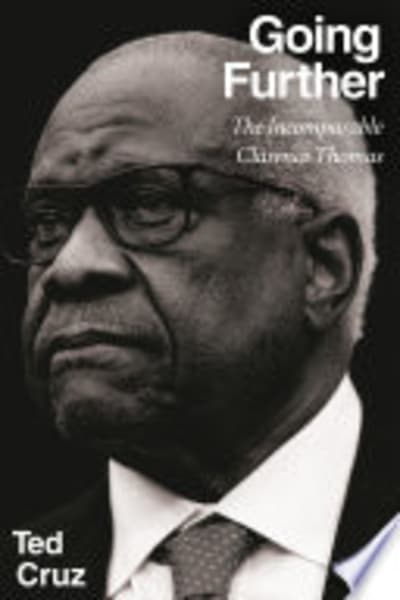
Going Further is structured around Ted Cruz’s claim that Clarence Thomas is best understood through the Constitution itself, not through the Court’s usual precedent-first habits—and Cruz keeps returning to that framework as he moves from Thomas’s childhood to his courtroom style. Early on, Cruz lays out Thomas’s formative years: segregated Georgia, “crushing poverty,” and the racism Thomas encountered before he ever became a legal celebrity. Cruz then uses a specific Thomas arc that includes a stint in radical left-wing politics and the early pull toward religious life, setting up Cruz’s core idea that Thomas learned independence before he learned doctrine. The book’s centerpiece is the personal access Cruz says he earned through nine hours of one-on-one interviews, which Cruz uses to explain how Thomas thinks when he’s drafting—especially his insistence that the Constitution’s meaning should govern even when precedent is comfortable.
One concrete example Cruz leans on is Thomas’s long-standing skepticism toward judges treating past decisions as a kind of constitutional substitute. Cruz contrasts that with what he portrays as a more “living document” instincts in parts of the legal culture, then argues that Thomas’s approach is both disciplined and emotionally grounded in his early experiences. Cruz also points to Thomas’s clerkship and later advocacy work as the bridge between life lessons and legal method, so the book reads less like a generic biography and more like a guided tour of how Thomas’s worldview became legal reasoning.
Here’s the limitation: Cruz does not offer a neutral legal audit of every major Thomas opinion. If you’re hunting for a balanced critique of Thomas’s jurisprudential outcomes—or you want fewer personal anecdotes and more casebook-style analysis—you may feel the book is too invested in defending Thomas’s character and method.
Key Takeaways from Going Further
-
1
Constitution First: Cruz argues Thomas treats the text as the controlling authority, even when precedent would otherwise settle the question.
-
2
Nine Hours of Interviews: Cruz uses private conversations to explain how Thomas’s memory and temperament shape his drafting decisions.
-
3
Independence as Method: Thomas’s early self-reliance becomes, in Cruz’s telling, a legal habit of resisting judicial drift.
-
4
Early Encounters with Racism: Cruz frames these experiences as the emotional engine behind Thomas’s insistence on “truth” over institutional comfort.
-
5
Clerkship to Courtroom: Cruz connects Thomas’s early legal training to his later courtroom style and his skepticism of precedent-as-constitution.
Who Should Read This
Someone who’s spent the last few years arguing about constitutional interpretation—online or at family gatherings—will appreciate how Cruz ties Thomas’s method to lived experience. If you’re the kind of reader who wants to understand why a judge writes the way he does, not just what he decided, this will land.
Who Shouldn't Read This
If you want a tightly documented, fully impartial biography with equal time for criticisms of Thomas’s outcomes, Cruz’s defending posture will frustrate you. If you prefer dense case-law analysis over personal narrative and interviews, you’ll likely feel the book moves too much by persuasion and too little by legal machinery.
Editor's Verdict
The best part of Going Further is Cruz’s consistent “Constitution, not precedent” through-line, reinforced by Thomas’s life story and illustrated by Cruz’s discussion of how Thomas approaches drafting. The real limitation is that Cruz’s access and admiration often crowd out sustained counterarguments about Thomas’s judicial results. This book hits hardest for anyone who’s already formed a strong view of Thomas and wants language, story, and method to defend it—especially if you’re tired of hearing only caricatures.
Ready to read Going Further?
Get your copy on Amazon today.
Going Further — Frequently Asked Questions
About Ted Cruz
Ted Cruz (born December 22, 1970) is an American attorney and politician who served as U.S. Senator for Texas from 2013 to 2019 and as U.S. Solicitor General (2016–2018). He earned his J.D. from Harvard Law School and worked in private practice and at the federal government. He is credible on constitutional and legal policy topics addressed in Going Further. Other notable works include A Time for Truth and Notorious R.B.G.