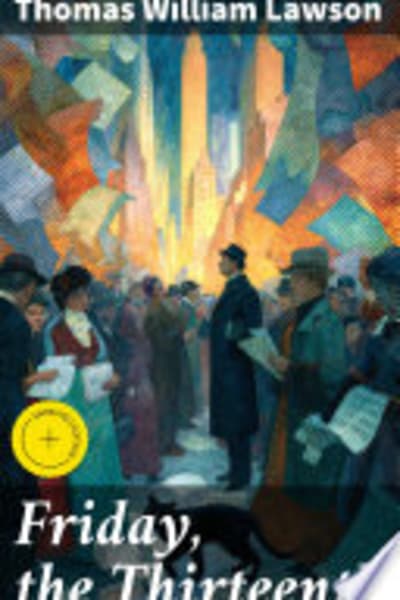
Friday, the Thirteenth: A Novel — Book Summary & Review
Last updated:
Public domain via Project Gutenberg — free and legal.
Friday, the Thirteenth: A Novel Summary
Friday, the Thirteenth is built around a recurring superstition framework—Friday plus thirteen becomes a pressure-cooker that Lawson keeps testing against the decisions people make in the financial district. Lawson doesn’t treat fate as a poetic metaphor; he treats it like a tool for rationalizing greed. The plot’s structure keeps circling back to the titular day’s “logic,” and Lawson uses that logic to show how deception spreads faster than facts when everyone thinks the calendar is in charge. You watch characters bargain with themselves: one more shortcut, one more lie, one more “luck” adjustment, until the lie starts running the body instead of the mind.
Lawson’s background in volatile markets matters here, because the book’s social commentary moves through money mechanics—timing, rumor, leverage, and the way a crowd invents certainty. When characters talk about luck, Lawson makes you feel how belief in luck can become a substitute for discipline. He also keeps the psychological pressure tight: the fear isn’t supernatural; it’s human, and it grows as soon as people realize they can influence what others believe.
A specific recurring beat is the way Lawson stages small social performances in offices and back rooms, then escalates them into public consequences as the day approaches. Even if you can guess where some moral lines will be drawn, the tension is in watching how ambition wears a mask of practicality.
Honest limitation: this novel is not interested in cozy ambiguity or modern pacing. If you want sleek plotting or morally “clean” resolutions, Lawson’s willingness to let characters stay compromised will likely frustrate you.
Key Takeaways from Friday, the Thirteenth: A Novel
-
1
Friday–Thirteenth Framework: Lawson turns the date into a decision excuse, showing how superstition becomes permission for risk.
-
2
Luck Rationalization: Characters use “luck” language to justify shortcuts, until self-deception becomes policy and then habit.
-
3
Financial District Pressure: The setting functions like a pressure chamber where rumor and money move together faster than conscience.
-
4
Deception as Momentum: Lawson treats lies as a system—once started, they force more lies to keep the first one alive.
-
5
Moral Ambiguity of Ambition: The book argues that ambition’s face can change while the underlying motive stays stubbornly selfish.
Who Should Read This
Someone who’s been wrestling with how fear or superstition sneaks into “rational” choices—especially around money or work—will get traction from Friday, the Thirteenth. If you’ve ever watched a team or community invent certainty to justify questionable moves, Lawson’s financial-district psychology will feel uncomfortably familiar.
Who Shouldn't Read This
If you want a modern, fast, emotionally tidy novel with clear moral accounting, Lawson will frustrate you with his refusal to sanitize motives. If you dislike older writing styles and prefer tight, contemporary pacing, the book’s dated structure and emphasis on social maneuvering may feel slow or repetitive.
Editor's Verdict
The single best thing Friday, the Thirteenth does is convert the titular superstition into a working engine for deception, especially as the date’s “logic” tightens around financial choices. The real limitation is that Lawson is more interested in moral and psychological pressure than in satisfying plot mechanics, so some turns will feel predetermined rather than earned. This hits hardest for anyone mid-career questioning why they work so hard, right after a setback when excuses for risk start sounding persuasive.
Ready to read Friday, the Thirteenth: A Novel?
Get your copy on Amazon today.
Friday, the Thirteenth: A Novel — Frequently Asked Questions
About Thomas William Lawson
Thomas William Lawson (1850–1925) was an American writer and financier known for business journalism and novels about Wall Street. He worked in finance and became a prominent investor, giving him direct knowledge of speculative markets, corporate dealings, and the financial culture that shapes his fiction. He wrote Friday, the Thirteenth: A Novel (1911). Other notable works include The Money Changers (1901) and The Man Who Lost (1914).