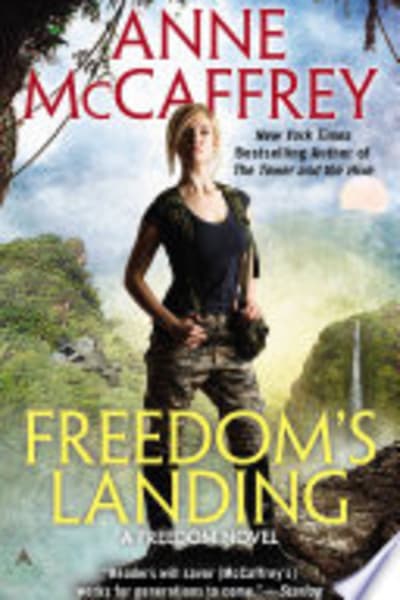
Freedom's Landing — Book Summary & Review
Last updated:
Freedom's Landing Summary
Freedom’s Landing is built around a brutal setup: Kristin Bjornsen watches slave laborers get herded into a penal colony ship, then the book pivots into what amounts to a survival curriculum—learning, growing, and bargaining inside a system designed to grind people down. McCaffrey’s structure keeps returning to the same pressure point: freedom isn’t a speech, it’s a series of small, risky decisions that must work under constant surveillance. One concrete example is the Denver-to-ship transition, where Kristin’s “normal life” ends in a single skyward sighting, and then the story locks onto practical resistance—who can be trusted, what can be stolen, what knowledge actually transfers. Later, the colony’s botany-based labor (the book’s imaginary ecological system) becomes more than scenery; it’s the way power is enforced, and also the way Kristin finds leverage. McCaffrey repeatedly shows that “knowledge” has a cost: every useful skill she acquires makes her more valuable to the captors and more dangerous to herself. The novel’s action-adventure beats land because they’re braided to that labor reality—escape plans aren’t fueled by vibes, they’re fueled by resources, timing, and the ability to read the colony’s routines.
Still, Freedom’s Landing doesn’t do everything: if you want courtroom politics, deep character interiority, or a slow-burn romance subplot, you’ll feel the book’s emphasis on momentum and competence. Kristin’s arc is satisfying, but secondary characters can read like roles in the machinery of the plot rather than fully fleshed lives. If you’re allergic to penal-colony worldbuilding and the constant threat of violence, McCaffrey’s choice to stay close to that machinery will frustrate you.
Key Takeaways from Freedom's Landing
-
1
Space-ship slave herding: The opening frames captivity as logistics, not ideology, so escape depends on timing and access.
-
2
Penal colony routines: The colony runs on predictable labor cycles; Kristin’s resistance is built around learning those patterns.
-
3
Imaginary botany system: Plant growth and ecological management aren’t decoration—they control who works, who eats, and who’s punished.
-
4
Kristin’s leverage strategy: McCaffrey treats freedom as bargaining power, earned through skills captors can’t easily replace.
-
5
McCaffrey’s competence plot: Action scenes are driven by practical problem-solving, not heroic speeches or pure luck.
Who Should Read This
Someone who feels trapped in a job or system where rules are enforced by routine will recognize Kristin Bjornsen’s problem: you can’t fight what you can’t map. If you’re craving sci-fi that uses labor and botany as the engine of resistance, McCaffrey’s approach will likely click for you.
Who Shouldn't Read This
If you want lots of psychological introspection and nuanced side characters, Freedom’s Landing may feel plot-forward and role-heavy. If penal-colony violence and coerced labor make you skim or rage-quit, McCaffrey keeps the pressure high and the subject matter stays concrete.
Editor's Verdict
The single best thing McCaffrey does is connect resistance to the colony’s practical labor ecosystem, especially the way botany-based work becomes both control and leverage during Kristin’s adaptation. The real limitation is that many supporting characters function mainly as plot instruments rather than fully developed emotional anchors. This hits hardest for anyone stuck in a “learn the rules, then survive them” phase of life—right before they try to break out and need a plan that respects how systems actually work.
Ready to read Freedom's Landing?
Get your copy on Amazon today.
Freedom's Landing — Frequently Asked Questions
About Anne McCaffrey
Anne McCaffrey was an American author and historian specializing in spaceflight and aviation history. She is credible on topics like space and exploration through her research-based writing and expertise in the development of space technologies and missions. She wrote Freedom’s Landing, which draws on historical knowledge of early spaceflight efforts. Other notable works include The Dragonriders of Pern series, co-authored with her mother, Anne McCaffrey, and further Pern-related titles.