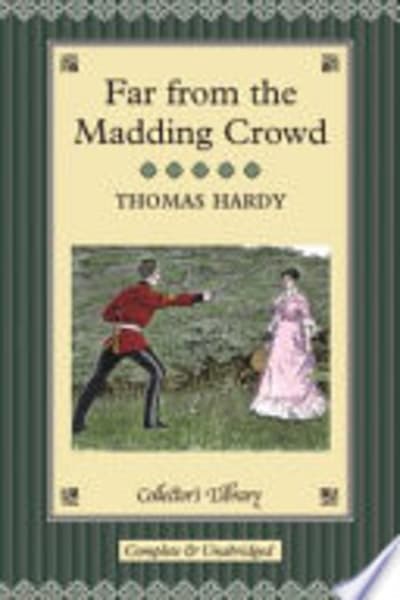
Far from the Madding Crowd — Book Summary & Review
by Thomas Hardy
Last updated:
Public domain via Project Gutenberg — free and legal.
Far from the Madding Crowd Summary
In Far from the Madding Crowd, Hardy builds the whole tragedy around Bathsheba Everdene’s “independent and spirited” self-direction colliding with three men who each want a different kind of control over her life. The novel is structured less like a tidy romance and more like a social weather report for Wessex: courtship, reputation, money, and land all push and pull until an apparently small choice becomes irreversible. Bathsheba arrives at Weatherbury to farm on Boldwood’s estate, and Hardy keeps returning to the practical details—work, barns, harvest timing—while he quietly sharpens the moral pressure around her. The triangle is clear from the start, but Hardy’s real interest is how Bathsheba’s confidence can look like freedom to her and like invitation to others.
Hardy’s most memorable run of scenes comes in the middle stretch where Troy’s charm turns into a pattern and Gabriel Oak’s devotion becomes a kind of patience that stops being comforting and starts being suffocating. The “slow courtship” part is partly a trick: Oak’s steadiness makes the fast seduction feel more dangerous by comparison, and Boldwood’s gentleman-farmer pride makes him react with a rigidity that tragedy can use. Hardy also gives you a brutal, communal viewpoint—people talk, rumors travel, and the community’s stability is treated like something you can accidentally crack with your private decisions.
One honest limitation: if you’re hunting for modern psychological realism or a heroine who consistently “learns her lesson” in a satisfying arc, Hardy will frustrate you. Bathsheba’s choices don’t resolve into tidy self-understanding; they land in a world that keeps going, and Hardy lets the consequences feel harsher than catharsis.
Key Takeaways from Far from the Madding Crowd
-
1
Bathsheba Everdene: Her independence reads as agency, but Hardy shows how quickly it becomes social leverage for men.
-
2
Weatherbury’s farm life: Work rhythms and land management aren’t backdrop; they determine who has power and who has time to wait.
-
3
Boldwood’s gentleman-farmer pride: His status makes his reactions rigid, so misunderstanding hardens into catastrophe.
-
4
Sergeant Troy’s seduction pattern: Troy isn’t a one-time villain; his charm operates like a repeatable method that erodes trust.
-
5
Gabriel Oak’s devoted shepherd patience: Oak’s loyalty functions as a moral gravity, pulling Bathsheba without fully respecting her autonomy.
Who Should Read This
If you’re in a phase where you keep re-litigating your own romantic “what went wrong” stories, this will feel uncomfortably accurate. Someone who likes rural realism plus interpersonal triangles will appreciate how Hardy treats desire as a social force, not a private mood.
Who Shouldn't Read This
If you want a fast, plot-forward romance with frequent emotional reversals, Hardy’s pace and communal focus will feel slow and occasionally cold. If you need characters to earn redemption through explicit learning, Bathsheba’s consequences won’t resolve into the kind of moral closure you’re expecting.
Editor's Verdict
Hardy’s best move is how he uses Wessex community life to make romance feel like public infrastructure—especially around the Troy/Oak/Boldwood pressure around Bathsheba Everdene. The real limitation is that the novel’s harshness isn’t softened by psychological consolation, so some readers will want more justice than Hardy provides. This hits hardest for anyone who’s just finished a relationship and is tempted to believe one “right choice” would have saved everything.
Ready to read Far from the Madding Crowd?
Get your copy on Amazon today.
Far from the Madding Crowd — Frequently Asked Questions
About Thomas Hardy
Thomas Hardy (1840–1928) was an English novelist and poet born in Higher Bockhampton, Dorset, and raised in a rural setting. He trained as an architect in Dorchester and later worked as a writer, drawing on firsthand knowledge of the region’s landscapes, dialects, and rural life. This makes him credible for writing about English country communities and their social dynamics. His other notable works include Tess of the d’Urbervilles and Jude the Obscure.