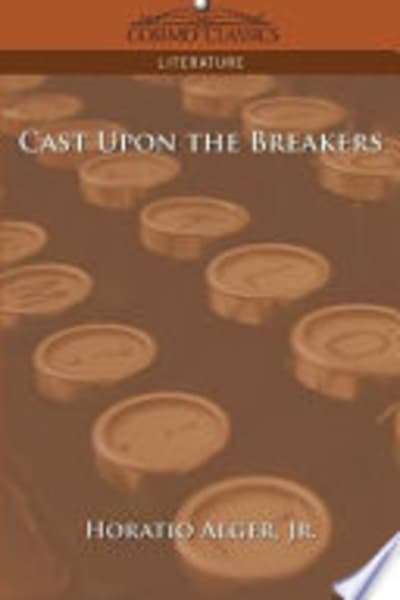
Cast Upon the Breakers — Book Summary & Review
Last updated:
Public domain via Project Gutenberg — free and legal.
Cast Upon the Breakers Summary
Cast Upon the Breakers opens by treating school as a temporary holding pattern, then immediately pivots to Rodney’s decision to “learn a trade” as the real test of character rather than the classroom itself. Alger structures the story around a sequence of working-life trials—hunger, job-seeking, and the constant pressure to cut corners—so Rodney’s friendships function like scaffolding: they don’t remove hardship, they keep him from falling into petty self-interest. One concrete moment that anchors the book is Rodney’s early reliance on a friend who offers practical help, not speeches, and the way Alger makes that friendship cost something (time, pride, and risk) instead of staying sentimental. Later, the plot turns on Rodney being “cast upon the breakers,” a phrase Alger uses to frame sudden reversals—an abrupt loss, a failed plan, or a public humiliation—where the question isn’t whether life is unfair, but whether Rodney stays loyal when no one is rewarding him.
If you want a named example, the book’s conduct-of-life emphasis shows up most clearly in Rodney’s repeated choices about honesty and perseverance after poverty closes doors. Alger keeps returning to the same moral mechanism: small acts of decency accumulate until they become a kind of social capital, and that capital matters when Rodney needs allies. Alger also doesn’t let friendship float free of responsibility; Rodney is repeatedly expected to do the next right thing even when he’s tired, broke, or tempted to resent others.
The limitation is real: the book leans hard into 19th-century moral instruction and tidy resolution, so readers looking for psychological realism, morally gray characters, or a modern sense of systemic critique may feel the story is preaching rather than probing. Alger is writing to steer behavior, not to complicate it.
Key Takeaways from Cast Upon the Breakers
-
1
Rodney’s “learn a trade” pivot frames work as character training, not survival trivia, and Alger makes each setback a test.
-
2
Friendship in fiction operates as risk-sharing, where help costs Rodney time, pride, and safety, not just warm feelings.
-
3
Conduct of life in fiction is enforced through repeated small choices—honesty and perseverance—before any big turning point arrives.
-
4
Poverty in fiction is portrayed as a door-closing machine, pushing Rodney into moral decisions when options shrink fast.
-
5
“Cast upon the breakers” functions as Alger’s reversal mechanic, measuring loyalty and restraint when plans collapse publicly.
Who Should Read This
Someone who’s stuck in a rough stretch—bills overdue, a job search stalling, and friends feeling unreliable—will recognize Rodney’s “next right thing” rhythm. If you’re trying to decide whether loyalty is worth the hassle when you’re not winning yet, this book will meet you there.
Who Shouldn't Read This
Someone who wants modern, morally ambiguous storytelling will be disappointed by Alger’s heavy-handed virtue logic and clean moral outcomes. If you can’t stand 1970s reprints of older fiction’s didactic tone, you’ll likely find the conduct lessons louder than the plot.
Editor's Verdict
The single best thing Cast Upon the Breakers does is make friendship operational through Rodney’s choices under poverty pressure, especially during the early “learn a trade” shift that tests loyalty in real time. The real limitation is its insistence on moral instruction with tidy emotional payoffs, which reduces complexity and can feel preachy. This hits hardest for anyone who’s recently burned out on cynical self-protection and needs a story that argues decency is practical, not decorative.
Ready to read Cast Upon the Breakers?
Get your copy on Amazon today.
Cast Upon the Breakers — Frequently Asked Questions
About Horatio, Jr. Alger
Horatio, Jr. Alger (1832–1899) was an American author and publisher best known for boys’ and family adventure and moral reform fiction. Born in Massachusetts, he worked in publishing and journalism and wrote numerous popular novels for young readers. He is credible on maritime hardship and shipwreck themes because he drew on widely reported 19th-century sea disasters and contemporary popular interest in coastal survival narratives. Other notable works include Ragged Dick and The Young Outlaw.