Brave New World — Book Summary & Review
Last updated:
Brave New World Summary
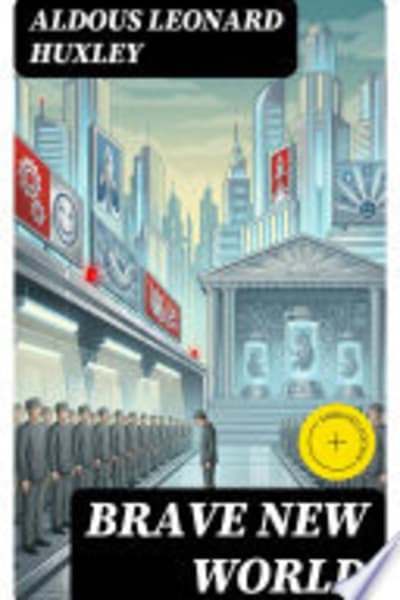
Brave New World begins by introducing the World State's motto: 'Community, Identity, Stability.' Huxley uses this framework to critique a society obsessed with uniformity and control. In Chapter 3, the concept of 'Soma' — a government-distributed drug used to maintain public contentment — highlights the sacrifice of individuality for collective happiness. Huxley's narrative follows Bernard Marx and Lenina Crowne, whose visit to the Savage Reservation starkly contrasts the sterile perfection of their world with the raw humanity of the 'savages.' The book doesn't offer a roadmap for resisting societal control, which might frustrate readers seeking actionable solutions. Instead, it serves as a cautionary tale about the dangers of sacrificing freedom for comfort, making it a powerful reflection on modern society's struggles with technology and control.
Key Takeaways from Brave New World
-
1
Soma: A drug symbolizing the suppression of individual emotions for societal stability, highlighting the cost of enforced happiness.
-
2
Bokanovsky's Process: A method of cloning humans to create a uniform, controllable population, raising ethical questions about genetic engineering.
-
3
Hypnopaedia: Sleep-teaching used for indoctrination, illustrating the power of propaganda and conditioning in shaping societal values.
-
4
Savage Reservation: A place untouched by the World State's control, offering a glimpse into the natural human condition and cultural diversity.
-
5
Feelies: Sensory films that distract citizens from reality, showcasing the use of entertainment as a tool for social control.
Who Should Read This
Someone who feels uneasy about the growing role of technology in everyday life will find this book unsettling yet enlightening. If you're questioning the balance between individual freedom and societal control, Huxley's narrative will resonate deeply.
Who Shouldn't Read This
If you're looking for actionable steps to combat societal issues, this isn't your book. The narrative is more a philosophical exploration than a practical guide, which might frustrate readers seeking direct solutions.
Editor's Verdict
The book's depiction of 'Feelies' perfectly encapsulates its critique of entertainment as a means of societal control. Its lack of actionable solutions might disappoint readers looking for practical advice. If you're reflecting on the ethical implications of technology in society, this book will hit hardest.
Ready to read Brave New World?
Get your copy on Amazon today.
Brave New World — Frequently Asked Questions
About Aldous Huxley
Aldous Huxley (1894-1963) was a British writer and philosopher, renowned for his dystopian novel "Brave New World" (1932). Born into a prominent intellectual family, Huxley studied at Eton College and Balliol College, Oxford. His background in literature and science informed his exploration of societal and technological themes. Huxley's credibility on dystopian topics stems from his incisive critique of contemporary culture and foresight into future societal trends. Other notable works include "The Doors of Perception" (1954) and "Island" (1962).