Appreciations of Richard Harding Davis — Book Summary & Review
by Various
Last updated:
Public domain via Project Gutenberg — free and legal.
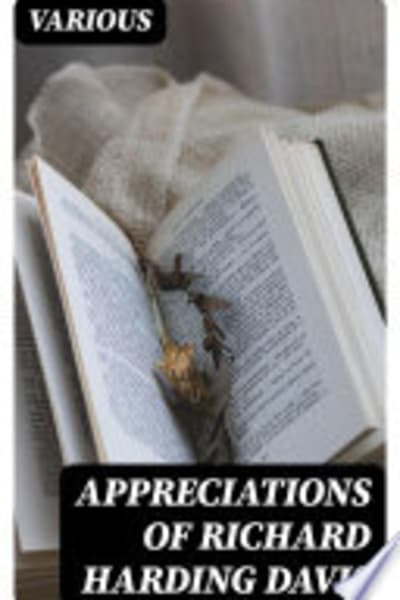
Appreciations of Richard Harding Davis Summary
In Appreciations of Richard Harding Davis, the editor frames the whole volume as a set of short critical tributes, each one circling back to Davis’s wartime reporting identity and what that meant for his fiction and drama. The book is organized more like a gallery wall than an argument you debate: you move from one writerly “appreciation” to the next, and the pattern becomes clear—Davis is treated as a craftsman whose observational habits were forged in conflict zones, then retooled for stage and page. Across the pieces, you keep seeing the same anchor points: Davis as the first American war correspondent covering the Spanish–American War, then the Second Boer War, and later the First World War, with the implication that his credibility came from being in the room when history got loud. The appreciations also push a specific claim about Davis’s voice: his narrative energy isn’t only “journalistic fact,” it’s a dramatic rhythm—quick turns, crisp scenes, and a talent for making distant events feel socially immediate. One recurring section pattern (the book’s repeated “Davis as X” framing) effectively acts like a thesis without ever becoming a formal one, and it’s where the volume earns its existence. The limitation, though, is big and plain: this isn’t a systematic study of Davis’s themes or a guided reading list of his best stories; it’s a collection of admiring essays, so if you came looking for critique, you’ll mostly find praise. Also, because it’s short—about seventy-four pages—the individual appreciations can feel like snapshots rather than arguments. If you want a dense, chapter-by-chapter reading of Davis, you won’t get it; you’ll get a chorus, and the chorus is firmly pro-Davis.
Key Takeaways from Appreciations of Richard Harding Davis
-
1
Richard Harding Davis as war-correspondent: the book treats his reporting background as the engine behind his narrative authority.
-
2
Critical “appreciations” format: each essay functions like a focused tribute, building a mosaic rather than a single thesis.
-
3
Spanish–American War credibility: Davis’s early coverage is used to explain why readers trusted his later fiction and drama.
-
4
Second Boer War narrative habits: the volume links his observational style to scene construction and dramatic pacing.
-
5
First World War afterimage: Davis’s later work is framed as history filtered through character-driven immediacy.
Who Should Read This
Someone who’s already heard the name Richard Harding Davis but can’t tell whether he matters for more than war journalism. If you’re deciding whether to read Davis next and want a fast, admiration-heavy orientation, this will suit your mood.
Who Shouldn't Read This
If you want close textual analysis—paragraph-level commentary on Davis’s stories, plays, or narrative techniques—this collection will feel skimpy and repetitive. If you’re allergic to praise-only criticism and prefer essays that argue, disagree, and risk being wrong, you’ll be frustrated here.
Editor's Verdict
The best thing this book does is keep returning to Davis’s wartime correspondent identity as the reason his fiction and drama move with such practiced urgency, especially through the repeated attention to his Spanish–American War and later coverage. The real limitation is that it offers admiration more than analysis, so you won’t get sustained critique or a roadmap for reading Davis’s work. This hits hardest for someone standing at the “should I bother?” fork before starting Davis—mid-deciding whether to invest time in him.
Ready to read Appreciations of Richard Harding Davis?
Get your copy on Amazon today.
Appreciations of Richard Harding Davis — Frequently Asked Questions
About Various
Various is the credited author/editor of Appreciations of Richard Harding Davis. The collection presents critical and commemorative writings about Richard Harding Davis, drawing on contemporary and later commentary to contextualize his career as an American journalist and writer. Various is credible on this topic because the work compiles and organizes multiple authoritative perspectives on Davis rather than relying on original speculation. Other notable works by “Various” are not reliably identifiable without additional publication details.