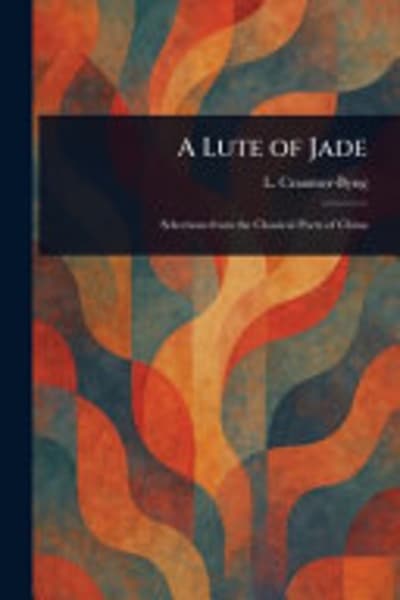
A Lute of Jade : Selections from the Classical Poets of China — Book Summary & Review
by L. (Launcelot) Cranmer-Byng
Last updated:
Public domain via Project Gutenberg — free and legal.
A Lute of Jade : Selections from the Classical Poets of China Summary
In A Lute of Jade, Cranmer-Byng organizes the book as selections from China’s classical poets, letting the translations do the heavy lifting while he quietly signals what kind of “Chinese poetic tradition” the reader is meant to feel. The most noticeable through-line is how Cranmer-Byng treats imagery as a system: nature isn’t backdrop, it’s a language for mood, status, and longing. You can feel that approach right away in the way he clusters poems around recurring emotional weather—moonlight, rivers, seasonal change—so the anthology starts to read like a map of sensations rather than a random sampling.
One concrete example is how Cranmer-Byng’s choices handle love and separation: he favors restraint over melodrama, so the ache lands through phrasing and pacing, not speeches. Another example is the anthology’s repeated attention to loss—grief as something observed, measured, and carried—where the translation decisions keep the poems spare enough that you can project your own history onto them. That’s the translator’s real argument in practice: classical Chinese verse survives translation by staying disciplined about what it shows.
Still, Cranmer-Byng doesn’t give you a guided tour of historical context or a course in classical forms. If you want footnoted explanations of each poet’s era, political situation, or technical structure, you’ll have to supply that elsewhere. The book is also more “readable selections” than a sustained narrative—if you’re buying for continuity, you may feel the seams between poets.
Key Takeaways from A Lute of Jade : Selections from the Classical Poets of China
-
1
Cranmer-Byng’s selection method: poems are grouped to make recurring images feel like a coherent emotional vocabulary.
-
2
Nature imagery framework: rivers, moon, and seasons function as coded mood markers, not scenery.
-
3
Translation discipline: phrasing stays restrained so longing and loss land without melodrama.
-
4
Love-and-separation emphasis: the anthology prefers quiet distance over explicit declarations.
-
5
Loss-as-observation model: grief is treated as something watched and measured, inviting your projection.
Who Should Read This
If you’re trying to read poetry without drowning in theory—especially when you want emotion to come through cleanly—this is for you. Someone who keeps collecting “world literature” books but rarely actually reads them might use A Lute of Jade as a low-friction entry point.
Who Shouldn't Read This
If you need historical context and technical breakdowns for every poem, Cranmer-Byng will frustrate you with how little scaffolding he provides. If you want a single authorial voice or narrative arc, the anthology format will feel fragmented and a bit thin.
Editor's Verdict
A Lute of Jade is at its best when Cranmer-Byng lets recurring imagery do the work—moon, water, seasons—so the poems communicate feeling through restraint. The real limitation is that Cranmer-Byng largely avoids deep contextual or formal explanation, leaving you to do extra background reading if you want it. This hits hardest for readers who are burned out on dense literary criticism and want classical Chinese poetry to feel immediate, not academic.
Ready to read A Lute of Jade : Selections from the Classical Poets of China?
Get your copy on Amazon today.
A Lute of Jade : Selections from the Classical Poets of China — Frequently Asked Questions
About L. (Launcelot) Cranmer-Byng
L. (Launcelot) Cranmer-Byng was a British writer and translator known for work on Chinese literature. He is credible on this topic because A Lute of Jade presents selections from classical Chinese poets in English, reflecting sustained engagement with Chinese poetic texts and translation practice. His other notable works include translations and literary studies related to Chinese culture and poetry, published in the same period as A Lute of Jade.