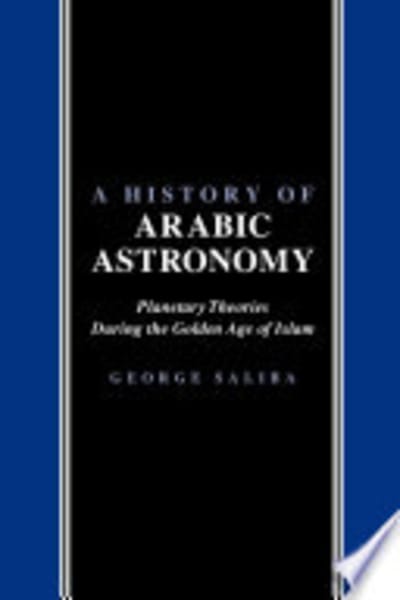
A History of Arabic Astronomy — Book Summary & Review
Last updated:
A History of Arabic Astronomy Summary
George Saliba’s A History of Arabic Astronomy is built around a recurring framework: he treats medieval Arabic astronomy as a living research tradition, not a shadow-copy of Greek science, and he uses specific case studies to show how technical choices shaped later theory. Early in the book, Saliba lays out how scholars translated, debated, and then modified inherited models—especially in the way planetary motion was argued for, not simply inherited. One concrete anchor is the discussion of the Maragha school’s observational and theoretical program; Saliba keeps returning to the idea that improved instruments and new data didn’t automatically “prove” a model, but forced mathematicians to revise the reasoning behind it. In later chapters, he zooms in on how debates over planetary parameters and models worked inside the tradition, including the stubborn question of what counts as an acceptable explanation versus a workable computational scheme.
Saliba also introduces the reader to the intellectual friction that makes this history interesting: people weren’t only doing math, they were negotiating authority, methods, and what “accuracy” meant in a world without modern calibration. The book’s chapter on observational practice and its consequences for planetary theory is where the argument feels most earned; he shows that Arabic astronomy’s achievements weren’t confined to results, but to the standards of argument that produced those results. If you want a specific example, pay attention to how Saliba connects theoretical revisions to institutional contexts and scholarly networks, because that’s his repeated move.
Honest limitation: this is not a guided primer for casual readers who want a clean timeline of discoveries. Saliba writes for people willing to tolerate technical terminology and dense historical argumentation, and he doesn’t pause to translate everything into modern astronomy’s language.
Key Takeaways from A History of Arabic Astronomy
-
1
Arabic astronomy as research tradition: Saliba argues the work evolved through debates and standards of proof, not simple transmission of Greek ideas.
-
2
Maragha observational program: he treats data collection and theoretical revision as coupled activities that reshaped planetary models over time.
-
3
Planetary theory standards: Saliba emphasizes how “acceptable explanation” and “workable computation” were contested inside the tradition.
-
4
Scholarly networks and institutions: he links technical change to who had access to instruments, texts, and patronage, not only to abstract genius.
-
5
Translation and modification: Saliba shows that translation was followed by argument—corrections, reinterpretations, and method changes that altered the science.
Who Should Read This
Someone who’s tired of “Arab science = copies of Greece” narratives and wants a historically grounded argument should read Saliba. If you’re preparing a paper or teaching unit on medieval astronomy and need concrete examples of how theory and observation interacted, Saliba is a strong fit.
Who Shouldn't Read This
If you want a smooth, beginner-friendly overview of astronomy milestones, Saliba’s dense technical-historical style will frustrate you. If you expect a faith-and-cosmos book that centers spirituality over methods, this one will feel relentlessly academic and method-driven.
Editor's Verdict
Saliba’s best move is his sustained linkage of observational practice to planetary theory, especially in the sections where he treats the Maragha program as an engine for argument, not just measurement. The limitation is that the book assumes patience with technical language and historical debate, and it offers little hand-holding for newcomers. This hits hardest for anyone mid-career who’s suddenly realizing their understanding of “scientific progress” is too simplistic and needs a more rigorous historical account from Saliba.
Ready to read A History of Arabic Astronomy?
Get your copy on Amazon today.
A History of Arabic Astronomy — Frequently Asked Questions
About George Saliba
George Saliba is an American scholar of the history of science, specializing in medieval Middle Eastern astronomy. He is credible on Arabic astronomy through long-term academic research and publication on Islamic scientific traditions and their transmission. Saliba is the author of A History of Arabic Astronomy. He has also written Islamic Science and the Making of the European Renaissance and co-edited The Oxford Handbook of the History of Physics.