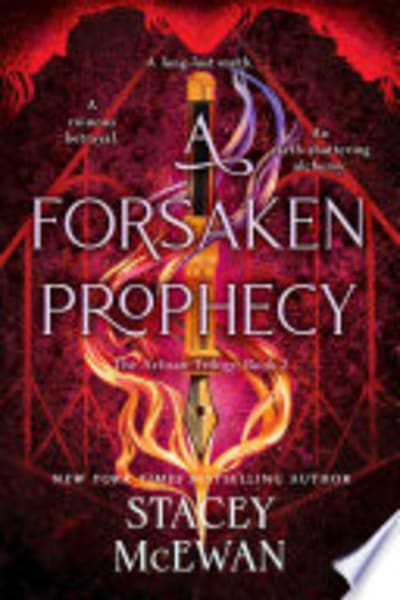
A Forsaken Prophecy — Book Summary & Review
Last updated:
A Forsaken Prophecy Summary
In A Forsaken Prophecy, Stacey McEwan builds the plot around a very specific “prophecy + idium” engine: decode what’s foretold, chase the resource, and let that chase decide who gets to be loyal. Nina and Patrick don’t get a romantic reset; they get dragged back into captivity, broken alliances, and the kind of political math that makes feelings feel like liabilities. McEwan structures the follow-up like a series of escape-and-interrogate sequences—first the narrow getaway after Patrick’s Alchemist rebel union is thrown into jeopardy, then the scatter across Craftsman towns where old friends show up with new grudges. The book also leans hard on relationship friction: Patrick has other things to worry about besides Nina’s betrayals, and the text keeps reminding you that forgiveness is not a plot coupon. One scene that crystallizes McEwan’s priorities is the run-up to decoding the ancient prophecy; the decoding doesn’t arrive as mystical fluff, it becomes a tactical problem with real consequences for who controls information. Another is the way Nina’s first love, Theo, functions as a hinge character—helpful, dangerous, and emotionally loaded, depending on what Nina needs in that moment.
McEwan’s central idea is that “war” is sustained by supply chains and stories, not just swords: idium isn’t only a MacGuffin, it’s the lever that could make the Artisans’ power look inevitable—or temporary. The limitation: if you’re expecting a clean, satisfying wrap-up, this installment leaves you in motion, with answers partially doled out and several threads clearly positioned for later books. Also, the pace can feel uneven because the prophecy hunt competes with repeated capture-escape beats, so patience matters more than mood.
Key Takeaways from A Forsaken Prophecy
-
1
Idium: the supposed infinite supply functions as the war’s real currency, turning prophecy into logistics rather than vibes.
-
2
Ancient prophecy decoding: McEwan treats interpretation as a tactical step, where information control changes alliances on the ground.
-
3
Alchemist rebel union: Patrick’s faction politics stay messy, so “rebellion” looks less heroic and more precarious.
-
4
Earth Charmer Nina: Nina’s power is tied to trust and betrayal costs, not just romantic tension or spectacle.
-
5
Theo as a hinge: Theo’s first-love role keeps re-routing the plot through favors that feel like threats.
Who Should Read This
Someone who’s already invested in Patrick and Nina’s toxic-tender chemistry and wants the stakes to keep escalating through prophecy, betrayal, and faction warfare will likely enjoy this. If you’re in the middle of a romantasy binge and you want more gangster-grit politics than pure courtship, McEwan delivers.
Who Shouldn't Read This
If you need a standalone story with a tidy ending, this will frustrate you because the prophecy and idium hunt are still in progress when the book ends. If you dislike repetitive capture-escape momentum and prefer slower character work, McEwan’s structure will feel too kinetic and uneven.
Editor's Verdict
The single best thing A Forsaken Prophecy does is make the “prophecy + idium” premise drive choices, especially during the prophecy-decoding push that turns mystery into leverage for the next conflict. The limitation is structural: the chase across Craftsman towns relies on repeated escalation beats and leaves multiple answers dangling for future installments. This hits hardest for anyone who read A Forbidden Alchemy In Belavere Trench and immediately wants the next installment’s faction war to keep tightening around Patrick and Nina.
Ready to read A Forsaken Prophecy?
Get your copy on Amazon today.
A Forsaken Prophecy — Frequently Asked Questions
About Stacey McEwan
I don’t have reliable information about Stacey McEwan or the author of A Forsaken Prophecy, including their background or other published works. I can’t write a factual bio without verified sources. If you share a link to an official author page, publisher listing, or credible interviews, I can draft a 60–80 word factual bio using only that information.