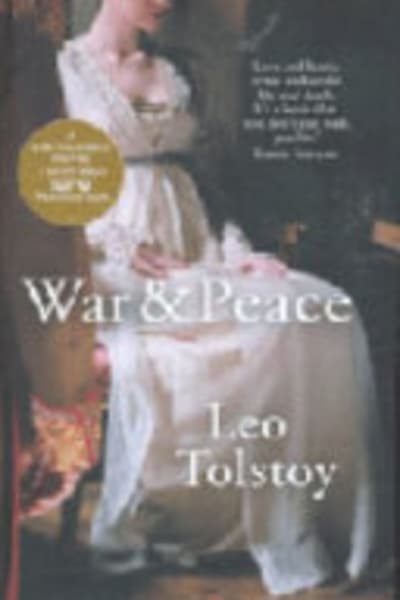
War and Peace — Book Summary & Review
by Leo Tolstoy
Last updated:
War and Peace Summary
In War and Peace, Tolstoy builds the novel around the contrast between Napoleon’s public myth and the messy, ordinary mechanics of history, then tests it through five aristocratic households as the clock moves from 1805 to 1812. You feel his framework early: the book keeps swapping scales—drawing-room talk, battlefield confusion, and long stretches of reflection—so “cause” never behaves like a clean lecture. Tolstoy follows the Bezukhovs’ shaky legitimacy and family rupture, the Bolkonskys’ rigid duty and private steel, the Rostovs’ warm spending habits, the Kuragins’ social polish with moral rot, and the Drubetskoys’ careerist hunger, letting private choices collide with public catastrophe. A concrete example is the way Tolstoy stages the 1805 campaigns with an almost administrative obsession: orders, miscommunications, fear, weather, and exhaustion. Another is how he repeatedly returns to the same emotional questions—pride, loyalty, vanity—across settings, so the Napoleonic invasion isn’t just “plot,” it’s a pressure system that reveals character. When Tolstoy zooms out, he argues that history is not driven by a single genius but by countless interacting motives, many of them trivial, misread, or accidental; when he zooms in, he shows how those motives look from inside a person’s day. This is also a book that frustrates: it does not offer a tidy romantic payoff or a streamlined reading experience, and if you want constant momentum and clear chapter-by-chapter “progress,” Tolstoy will test your patience. I finished it, but I understand why people quit—his scale is the point, yet it can feel like he’s refusing to hurry for your comfort.
Key Takeaways from War and Peace
-
1
Napoleonic myth vs lived history: Tolstoy treats grand reputations as theater, while battles and decisions emerge from confusion and human limits.
-
2
Five-family structure: The Bezukhov, Bolkonsky, Rostov, Kuragin, and Drubetskoy arcs act like lenses on the same era’s moral weather.
-
3
1805-to-1812 time sweep: The timeline forces you to watch consequences accumulate slowly, with the 1812 invasion landing as an overdue reckoning.
-
4
Reflection as method: Tolstoy interrupts scenes with historical and philosophical arguments, insisting that narration is part of the argument.
-
5
Character under pressure: Pride, duty, and ambition don’t stay abstract; Tolstoy shows how they mutate when war rearranges everyday choices.
Who Should Read This
Someone who likes long-form historical fiction and can tolerate philosophical detours—especially if you’re tired of stories where “history” is just a backdrop—should read War and Peace. If you’ve ever wondered why big events don’t feel like the movies afterward, Tolstoy’s focus on ordinary motives will land hard.
Who Shouldn't Read This
If you need momentum every few pages, War and Peace will feel padded because Tolstoy repeatedly slows down for lectures and extended social scenes. If you only want romance or only want battle action, Tolstoy’s deliberate mix of both—and his refusal to prioritize one—will frustrate you.
Editor's Verdict
The best thing Tolstoy does is make the argument about historical agency feel embodied, especially through the shifting focus from aristocratic salons to the confusion of the 1805 campaigns. The real limitation is the book’s structure: it is relentlessly digressive, with long reflective passages that can stall readers who want plot-first pacing. This hits hardest for anyone who’s mid-career or mid-life and feels irritated by simplified “one person caused it” stories—then watches Tolstoy dismantle that instinct scene by scene.
Ready to read War and Peace?
Get your copy on Amazon today.
War and Peace — Frequently Asked Questions
About Leo Tolstoy
Leo Tolstoy (1828–1910) was a Russian writer and moral thinker born into an aristocratic family at Yasnaya Polyana. He served in the Russian army and later lived through major social and political changes in 19th-century Russia, giving him firsthand knowledge of war and society. His credibility on military and civilian life is reflected in his detailed depiction of the Napoleonic era. Notable works include Anna Karenina and The Death of Ivan Ilyich.