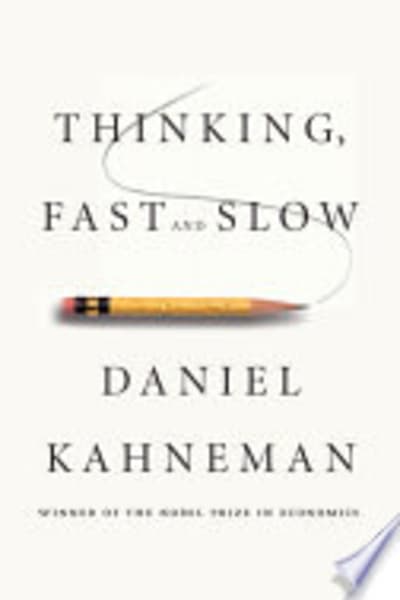
Thinking, Fast and Slow — Book Summary & Review
Last updated:
Thinking, Fast and Slow Summary
Daniel Kahneman introduces the dichotomy of 'System 1' and 'System 2' thinking, a framework that underpins his analysis of human decision-making. System 1 is quick and automatic, while System 2 is more deliberate and logical, a concept detailed in the chapter 'The Lazy Controller.' Kahneman uses relatable examples, like the 'bat and ball' problem, to illustrate how easily we can be misled by our intuitive judgments. A highlight is the exploration of the 'illusion of validity' and its impact on confidence in decision-making, especially in professional settings. While the book is dense with psychological studies and experiments, it doesn't provide a straightforward, step-by-step guide for practical application, which might frustrate readers looking for immediate actionable strategies.
Key Takeaways from Thinking, Fast and Slow
-
1
System 1 Thinking: Fast and instinctual, often leading to cognitive biases and errors, like misjudging probabilities.
-
2
System 2 Thinking: Slow and deliberate, requiring more effort and often correcting the mistakes of System 1.
-
3
The Anchoring Effect: Initial exposure to a number influences subsequent judgments and decisions, irrespective of its relevance.
-
4
Loss Aversion: People prefer avoiding losses to acquiring equivalent gains, a key principle in behavioral economics.
-
5
The Planning Fallacy: Tendency to underestimate the time, costs, and risks of future actions, leading to optimistic forecasts.
Who Should Read This
Someone who finds themselves consistently baffled by irrational decisions, either personal or professional. If you're grappling with understanding why smart people make foolish choices, this book offers clarity.
Who Shouldn't Read This
If you're looking for a quick, easy read, this book's dense psychological jargon and complex studies will likely frustrate you. Readers expecting a clear, actionable self-help guide may find Kahneman's academic approach lacking in immediate utility.
Editor's Verdict
Kahneman excels in breaking down complex psychological concepts into relatable anecdotes, especially the 'illusion of validity.' However, the book's academic style and depth can feel overwhelming without a solid interest in psychology or economics. This is best suited for anyone ready to challenge their cognitive processes, especially if they're at a crossroads in their career or personal decision-making.
Ready to read Thinking, Fast and Slow?
Get your copy on Amazon today.
Thinking, Fast and Slow — Frequently Asked Questions
About Daniel Kahneman
Daniel Kahneman is a psychologist and Nobel laureate born in 1934 in Tel Aviv. He is renowned for his work in behavioral economics and cognitive psychology, particularly decision-making and judgment under uncertainty. Kahneman's credibility stems from his extensive research, which earned him the 2002 Nobel Memorial Prize in Economic Sciences. Besides "Thinking, Fast and Slow," he co-authored "Judgment Under Uncertainty: Heuristics and Biases" and "Noise: A Flaw in Human Judgment."