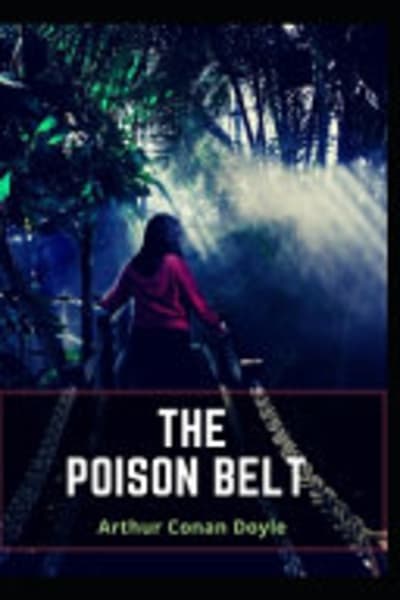
The Poison Belt — Book Summary & Review
Last updated:
Public domain via Project Gutenberg — free and legal.
The Poison Belt Summary
Professor Challenger’s habit of treating “facts” like weapons is the core engine of The Poison Belt, and the book’s structure keeps feeding that attitude through alternating viewpoints with Lord John Roxton and Professor Summerlee. Arthur Conan Doyle doesn’t rehash the Lost World premise so much as escalate it: the supporting cast is already proven, and now Challenger’s confidence turns into a kind of experimental obsession. The climax hinges on the titular hazard—poisonous gas trapped within a particular belt of space in the story’s pseudo-scientific framework—and Doyle stages it like a field report written by someone who can’t stop arguing with reality.
One of the most concrete, memorable set pieces is the expedition sequence where Challenger pushes the team to interpret odd atmospheric behavior as evidence of an active, hidden system rather than a natural accident. Roxton’s practical courage keeps the plot from becoming pure theory, while Summerlee functions as the skeptical counterweight who forces the story to explain itself. Doyle also gives you a classic “science lecture” rhythm: a problem appears, Challenger insists on a model, someone challenges the model, and then the narrative tests it under pressure.
If you’re expecting fully modern science, you won’t get it—Doyle’s explanations are confidently speculative and often more about momentum than mechanism. Still, Challenger’s voice is fun in a very specific way: you can almost feel the author enjoying the friction between hubris and discovery. The Poison Belt is short enough that it stays brisk, but it also means you won’t linger in the science for long, so the book may feel like argument plus action rather than sustained inquiry.
Key Takeaways from The Poison Belt
-
1
Professor Challenger’s method treats uncertainty like fuel, pushing hypotheses forward even when Summerlee questions the evidence.
-
2
The Poison Belt functions as a plot mechanism, translating a speculative atmospheric idea into clear, immediate dangers for the crew.
-
3
Lord John Roxton’s role anchors the story in physical courage, balancing Challenger’s rhetoric with on-the-ground decisions.
-
4
Professor Summerlee acts as the skeptic framework, repeatedly forcing the team to justify claims before consequences arrive.
-
5
The Lost World connection matters because Doyle reuses established dynamics, so the tension is interpersonal as much as scientific.
Who Should Read This
If you’re the kind of reader who loves brisk, old-school adventure where big ideas get tested by immediate danger, this will scratch the itch. Someone who wants a short Challenger outing—preferably after enjoying The Lost World—will get the most pleasure from the cast chemistry.
Who Shouldn't Read This
If you need careful, modern-style scientific plausibility, Doyle’s pseudo-science will frustrate you quickly. If you dislike lecture-heavy dialogue and prefer plot-only pacing, you may find the Challenger-versus-Summerlee arguments drag at key moments.
Editor's Verdict
The single best thing The Poison Belt does is keep Challenger’s argumentative momentum productive, especially during the expedition scenes where his model for the belt’s hazard is challenged by Summerlee and then stressed by events. The real limitation is that the science is confidently speculative and doesn’t offer the kind of rigorous explanation many readers now expect from science fiction. This hits hardest for anyone re-entering Doyle after a long break from Victorian adventure, when you want the comfort of familiar character friction and fast stakes.
Ready to read The Poison Belt?
Get your copy on Amazon today.
The Poison Belt — Frequently Asked Questions
About Arthur Conan Doyle
Arthur Conan Doyle (1859–1930) was a Scottish-born physician and writer best known for detective fiction. He studied medicine at the University of Edinburgh and worked as a doctor, giving him scientific training relevant to medical and forensic topics. He wrote The Poison Belt (1913), a science-fiction story involving a deadly atmospheric phenomenon. He is also the author of Sherlock Holmes stories and novels, including A Study in Scarlet and The Hound of the Baskervilles.