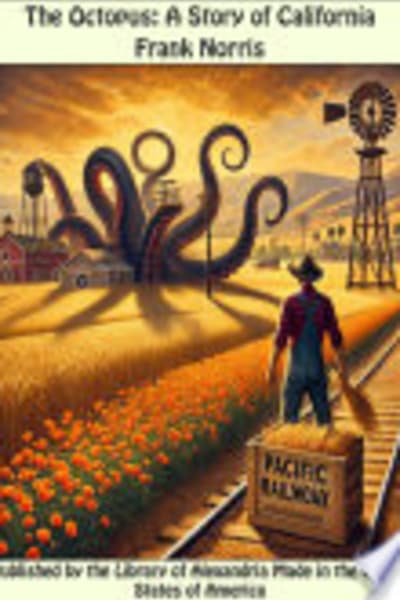
The Octopus : A Story of California — Book Summary & Review
by Frank Norris
Last updated:
Public domain via Project Gutenberg — free and legal.
The Octopus : A Story of California Summary
Frank Norris structures The Octopus around a railroad-versus-farmers premise, then uses it as a blunt indictment of the Central Pacific Railroad’s power over ordinary wheat growers. From early on, Norris frames the conflict through the economics of wheat—credit, leases, and the slow strangling of ranchers who can’t outlast a corporation’s leverage. The Mussel Slough Tragedy hangs over the novel like a verdict already delivered, and Norris keeps returning to the same moral math: when a rail monopoly controls access to markets, “choice” becomes a costume. One of the book’s sharpest moves comes in the way Norris shows the ranchers’ anger turning into organized resistance, while the railroad’s agents hide behind paperwork, contracts, and “order.” You feel Norris’s strategy: he doesn’t merely tell you that corporations are cruel; he shows how cruelty is manufactured—through delays, intimidation, and the careful conversion of people into obstacles.
Norris also makes the wheat itself feel like a character. Grain is hope in one chapter and a trap in the next, because the railroad’s reach makes the harvest’s value depend on forces the farmers can’t touch. Even the novel’s intended trilogy shape matters: The Octopus was planned as part one of The Epic of the Wheat, and its momentum keeps pointing forward to a larger system Norris never fully completes. That incompletion is the cost of buying in: you get a strong first installment of a bigger argument, but you also feel the missing third act.
If you want a tidy courtroom-style resolution or a fully rounded cast arc for everyone involved, Norris will frustrate you. This book is angry, ideological, and sometimes schematic—less interested in interior tenderness than in exposing how rural life gets crushed by infrastructure.
Key Takeaways from The Octopus : A Story of California
-
1
Central Pacific Railroad Monopoly: Norris treats corporate reach as a physical force that reshapes contracts into traps for wheat farmers.
-
2
Mussel Slough Tragedy Shadow: The novel borrows real violence to argue that “legal” conflict can still end in blood.
-
3
Epic of the Wheat Trilogy Plan: The book reads like part one of a system-wide indictment, not a self-contained moral story.
-
4
Wheat as Character: Harvest economics drive the plot, making grain supply chains determine who gets to live with dignity.
-
5
Railroad Paperwork and Intimidation: Norris shows power operating through delays, leverage, and intimidation as much as through guns.
Who Should Read This
If you’re tired of corporate villainy being treated like a vague vibe and you want the machinery of leverage spelled out, you’ll likely enjoy Norris. Someone who’s ever watched a workplace or industry consolidate and squeeze small players will feel the book’s pressure in their bones.
Who Shouldn't Read This
If you dislike novels that prioritize argument over character nuance, The Octopus will feel heavy-handed and at times impatient. If you need closure and a fully completed trilogy arc, you’ll be annoyed that Norris died before finishing the third novel.
Editor's Verdict
The best thing Norris does is make the railroad’s dominance feel inevitable through the wheat-and-credit logic that keeps tightening around ranchers. The real limitation is that the novel is clearly only part one of The Epic of the Wheat, so its larger promise is cut off midstream. This hits hardest for anyone who’s recently felt small and replaceable inside a larger system—especially after reading about consolidation in modern industries and wanting the same anger, but with 1901 grit.
Ready to read The Octopus : A Story of California?
Get your copy on Amazon today.
The Octopus : A Story of California — Frequently Asked Questions
About Frank Norris
Frank Norris (1870–1902) was an American novelist and journalist known for naturalist fiction. Born in Chicago and educated in California, he wrote extensively about the American West, especially the economic forces shaping it. He is credible on The Octopus: A Story of California (1901) because he studied California’s railroad industry and its influence on agriculture while reporting and researching regional conditions. Other notable works include McTeague (1899) and The Pit (1903).