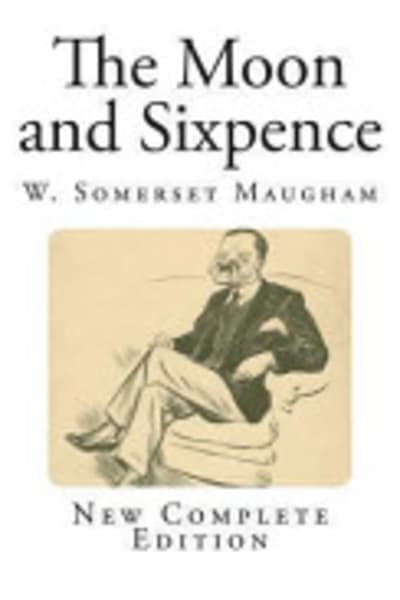
The Moon and Sixpence — Book Summary & Review
by W. Somerset (William Somerset) Maugham
Last updated:
Public domain via Project Gutenberg — free and legal.
The Moon and Sixpence Summary
In The Moon and Sixpence, Maugham builds the novel as a first-person account that keeps snapping back to Charles Strickland’s inner weather—his contempt for comfort, his need to make something true. The story begins with Strickland as an English stockbroker who treats stability like a joke; he sells himself off piece by piece until his life becomes a kind of experiment in what he can survive. Maugham’s real trick is how Strickland’s mind is presented as episodic and selective, so every “chapter” feels like a remembered incident rather than a smooth biography. We watch his marriage and his reputation collapse, then we watch him behave like a man who has decided that art is worth any humiliation. When Strickland finally drifts toward the orbit of other painters, Maugham doesn’t frame it as mentorship so much as recognition arriving late, like applause after the storm.
A concrete example: the novel’s recurring focus on Strickland’s scenes of work and his refusal of polite artistic training makes his “genius” feel suspiciously like obsession, not magic. Another example is how Maugham keeps returning to Strickland’s bodily and social degradation—poverty in Paris, the way he offends people by being too single-minded to perform gratitude. The book’s Gauguin influence is obvious, but Maugham isn’t writing a tidy art-history imitation; he’s writing about the psychology of someone who burns his old life down and expects the new one to ignite. Still, the limitation is that Strickland is hard to love: Maugham gives you plenty of access to his motives, but not much warmth, so readers wanting emotional payoff or moral clarity may feel stuck with a brilliant, prickly stranger.
Key Takeaways from The Moon and Sixpence
-
1
Charles Strickland’s Split Life: Maugham shows the break between respectable career and artist-identity as a slow self-erasure, not a dramatic switch.
-
2
First-Person Episodic Structure: the narration arrives in fragments, so you experience Strickland through moments rather than a coherent developmental arc.
-
3
Recognition After the Fact: the Dutch painter’s acknowledgment lands late, turning “success” into a delayed verdict on choices already made.
-
4
Paris Defiant Squalor: Strickland’s living conditions function as an argument—art requires subtraction, even if it looks like failure to others.
-
5
Gauguin Influence as Lens: Maugham uses Gauguin-like material to study obsession and consequence, not to deliver a historical explanation.
Who Should Read This
Someone who’s tired of tidy, inspirational artist stories and wants the messier psychology of someone who abandons everything for work will likely enjoy The Moon and Sixpence. If you’ve been wondering whether creative obsession is romantic or just destructive, Maugham’s Charles Strickland gives you a difficult, lived-in answer.
Who Shouldn't Read This
If you need a likable protagonist or a steady emotional arc, Maugham’s Strickland can feel abrasive, remote, and occasionally exhausting. If you want plot-heavy momentum, the novel’s episodic first-person structure may frustrate you because the “why” keeps mattering more than the “what happens next.”
Editor's Verdict
The single best thing The Moon and Sixpence does is make Strickland’s mind feel assembled from incidents—Maugham’s episodic first-person approach turns art-making into a recurring psychological problem. The real limitation is that Maugham centers an unsympathetic, self-authorizing man, so readers looking for comfort or moral grounding will leave with irritation rather than catharsis. This hits hardest for anyone mid-career who’s just started questioning why they keep chasing approval instead of building something they can live with.
Ready to read The Moon and Sixpence?
Get your copy on Amazon today.
The Moon and Sixpence — Frequently Asked Questions
About W. Somerset (William Somerset) Maugham
W. Somerset Maugham (William Somerset Maugham, 1874–1965) was an English writer and physician. He trained in medicine at St. Thomas’s Hospital in London and practiced briefly before turning to writing. His credibility on themes of human psychology and motivation comes from his career as a professional observer—both as a doctor and as a widely traveled author and playwright. He wrote The Moon and Sixpence (1919) and other notable works including Of Human Bondage (1915) and The Razor’s Edge (1944).