The Lucifer Effect — Book Summary & Review
Last updated:
The Lucifer Effect Summary
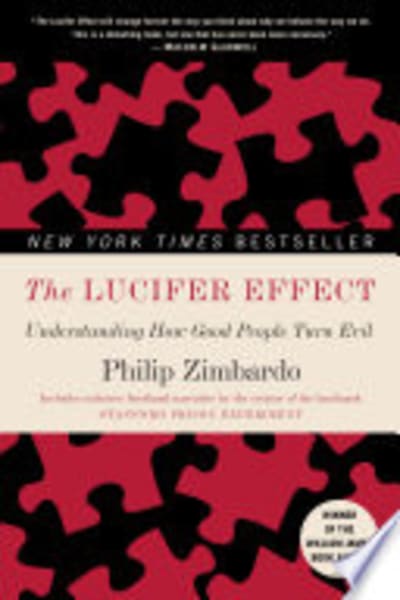
Philip Zimbardo's 'The Lucifer Effect' introduces the concept of the 'bad barrel' over the 'bad apple,' arguing that situational forces and systemic pressures can corrupt even the most virtuous individuals. The book is structured around Zimbardo’s infamous Stanford Prison Experiment, detailed extensively in a chapter named 'The Story of the Stanford Prison Experiment,' where college students swiftly transformed into abusive guards and submissive prisoners. Zimbardo expands this framework to analyze real-world atrocities, such as the abuses at Abu Ghraib, illustrating how normal people can commit horrendous acts under certain conditions. However, Zimbardo doesn't leave readers in despair; he explores the potential for heroism and resistance against evil. Despite the book's robust research and compelling examples, it can be dense and repetitive, which might deter readers looking for a more concise exploration of human behavior. The book's academic tone and detailed psychological analysis may frustrate those seeking a more straightforward narrative or immediate practical applications.
Key Takeaways from The Lucifer Effect
-
1
The Bad Barrel: Zimbardo argues that corrupt systems, not individuals, create evil actions by altering behavior through situational forces.
-
2
Stanford Prison Experiment: Demonstrates how quickly individuals conform to roles, leading to abusive behaviors within a structured environment.
-
3
Heroic Imagination Project: Proposes training to foster resistance to evil by visualizing oneself as a hero, counteracting negative influences.
-
4
Deindividuation: Explains how anonymity within groups reduces accountability, increasing the likelihood of immoral actions.
-
5
The Banality of Evil: Expands on Arendt's concept, showing how ordinary people commit evil acts under systemic pressures and authority.
Who Should Read This
Someone who is grappling with understanding how ordinary people can commit extraordinary acts of cruelty. If you're studying psychology or sociology and want to explore the depths of human behavior, this book offers a thorough analysis.
Who Shouldn't Read This
If you're seeking a light read or quick self-help tips, this book's academic tone and detailed research might be overwhelming. Readers looking for a concise narrative will find the extensive historical examples and analyses a bit tedious.
Editor's Verdict
Zimbardo excels in illustrating the power of situational forces with his detailed recount of the Stanford Prison Experiment. The book's dense and repetitive nature can be off-putting for those not deeply interested in academic psychological analysis. If you're questioning the thin line between good and evil in societal structures, this book is a powerful read that challenges your perceptions.
Ready to read The Lucifer Effect?
Get your copy on Amazon today.
The Lucifer Effect — Frequently Asked Questions
About Philip Zimbardo
Philip Zimbardo is an American psychologist and professor emeritus at Stanford University, renowned for his research in social psychology. He gained credibility on the topic of human behavior and evil through the infamous 1971 Stanford prison experiment, which he led to study the psychological effects of perceived power. Zimbardo authored "The Lucifer Effect," exploring how good people turn evil. Other notable works include "The Time Paradox" and "The Time Cure," co-authored with John Boyd.