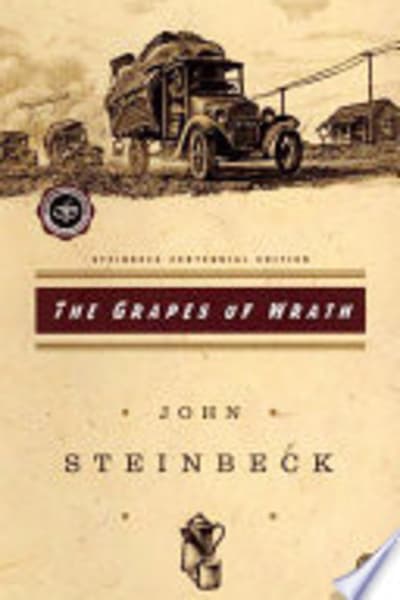
The Grapes of Wrath — Book Summary & Review
Last updated:
The Grapes of Wrath Summary
In The Grapes of Wrath, Steinbeck builds his case through the Joad family’s road-march structure and the book’s recurring “voices” that interrupt the plot to generalize what’s happening to farm laborers. The Joads leave Oklahoma because drought and debt squeeze the life out of sharecropping, then ride west in a battered truck with the kind of hope that’s less romance than refusal to stop. Once they reach California, Steinbeck shows the state of the workcamp economy with crushing specificity: hiring gates, wage theft in all but name, overcrowded housing, and a labor market that turns desperation into a tool for employers. The novel’s most memorable hinge is the strike conflict—when the Joads find themselves near efforts to organize and the machinery of replacement labor is set in motion, including the use of people desperate enough to cross picket lines. Steinbeck’s writing keeps returning to a single moral pressure: conscience is not an ornament; it costs you. The Joads’ flight from violence and exploitation isn’t clean or heroic, but it’s consistent with Steinbeck’s insistence that survival and complicity are always negotiating. He makes that argument vivid in scenes like the displacement logic that treats families as interchangeable units, and in the way the book tracks how hunger changes speech, posture, and even family roles. If you read Steinbeck expecting a neatly plotted “success” story, you’ll be disappointed: the novel refuses catharsis and keeps asking what you’re willing to do when the system makes decency expensive. The Grapes of Wrath also doesn’t aim to comfort readers with a tidy ending or a fully explained economic theory; it’s a moral indictment, not a policy manual.
Key Takeaways from The Grapes of Wrath
-
1
Sharecropping as a trap shows how “working the land” becomes debt bondage when drought hits.
-
2
The Joad family road structure turns migration into a repeating pattern of eviction and exploitation.
-
3
Strike-breakers in California reveals how employers weaponize desperation to break organizing efforts.
-
4
Conscience in motion means the characters’ moral choices carry real costs, not just private guilt.
-
5
Steinbeck’s intercalary “voices” generalize scenes into a broader social argument about labor.
Who Should Read This
Someone who’s spent years watching institutions grind people down—paychecks shrinking, jobs vanishing, dignity treated like optional—will feel the book’s pressure in their ribs. If you’re tired of stories where suffering is background noise, Steinbeck forces it to be the main event.
Who Shouldn't Read This
If you want a character-driven novel with minimal lecturing, Steinbeck’s interrupting social “voices” and generalized commentary will feel heavy-handed. If you’re looking for a hopeful, tightly resolved plot, The Grapes of Wrath will frustrate you with its refusal to deliver comfort.
Editor's Verdict
The single best thing Steinbeck does is make the strike-and-replacement system feel mechanical and human at the same time, especially in the book’s shift from organizing hope to coerced labor. The real limitation is that Steinbeck leans on broad, sermon-like interludes that can interrupt the emotional momentum for readers who prefer pure scene work. Anyone who’s just started a new job and feels uneasy about who gets blamed for structural problems will hit hardest when the novel frames conscience as something you pay for immediately.
Ready to read The Grapes of Wrath?
Get your copy on Amazon today.
The Grapes of Wrath — Frequently Asked Questions
About John Steinbeck
John Steinbeck (1902–1968) was an American novelist and journalist from California. He grew up in the Salinas Valley and worked as a reporter, later documenting the hardships of migrant farm workers during the Great Depression. His firsthand research and reporting make him credible on topics of poverty and displacement. He wrote The Grapes of Wrath (1939), and other major works include Of Mice and Men (1937) and East of Eden (1952).