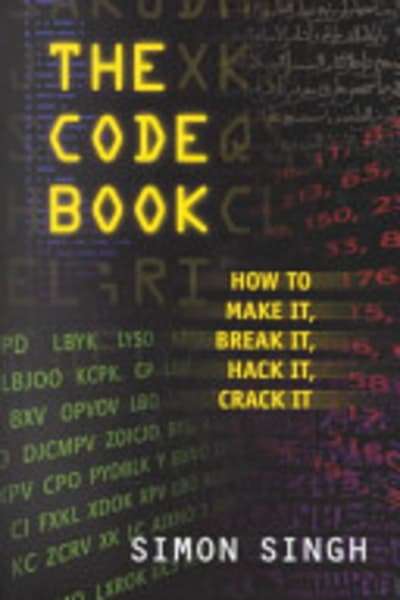
The Code Book — Book Summary & Review
by Simon Singh
Last updated:
The Code Book Summary
In *The Code Book*, Singh crafts a meticulously detailed narrative around the evolution of encryption, from ancient ciphers to the advent of digital cryptography. His chapter on the 'Vigenère Cipher' stands out, as it demystifies one of the most notorious 'unbreakable' codes and its eventual unraveling. Singh's exploration into the lives and minds of cryptanalysts like Alan Turing adds a human element to the technical subject. The book is rich with historical anecdotes, such as the use of the Enigma machine during World War II, which Singh presents with clarity and enthusiasm. However, readers seeking a deep technical manual on modern encryption might find the historical focus limiting, as Singh prioritizes storytelling over exhaustive technical detail.
Key Takeaways from The Code Book
-
1
The Vigenère Cipher: Singh explains how this once 'unbreakable' code was cracked, highlighting the evolution of cryptographic techniques.
-
2
The Navajo Code Talkers: This chapter details the critical role of Navajo language speakers in secure military communications during WWII.
-
3
Diffie-Hellman Key Exchange: Introduced as a groundbreaking method for secure digital communication, transforming how encryption operates online.
-
4
Zimmermann Telegram: Singh recounts how this coded message influenced the U.S. joining WWI, illustrating cryptography's political impact.
-
5
Public Key Cryptography: Described as a revolutionary concept, allowing secure communication without the need for a shared secret key.
Who Should Read This
Someone who is captivated by how codes have altered the course of history will find Singh's narrative style engaging and informative. If you're curious about the intersection of mathematics, war, and technology, this book will satisfy your interest.
Who Shouldn't Read This
If you're looking for a technical deep dive into modern cryptographic algorithms, Singh's historical approach may leave you wanting more. Those who prefer concise manuals over expansive narratives might find the book's breadth overwhelming.
Editor's Verdict
Singh's ability to weave historical events with cryptographic breakthroughs, like in the 'Zimmermann Telegram' chapter, is exceptional. However, the book's focus on history over technical depth may not satisfy cryptography purists. Dive into this book if you're pondering how secrecy shapes global events and enjoy narratives that bring technical topics to life.
Ready to read The Code Book?
Get your copy on Amazon today.
The Code Book — Frequently Asked Questions
About Simon Singh
Simon Singh is a British author and journalist, born in 1964. He holds a Ph.D. in particle physics from the University of Cambridge, establishing his credibility in scientific writing. Singh is renowned for his book "The Code Book," which explores the history of cryptography. His other notable works include "Fermat's Enigma," detailing the proof of Fermat's Last Theorem, and "Big Bang," which discusses the history of the universe's origins.