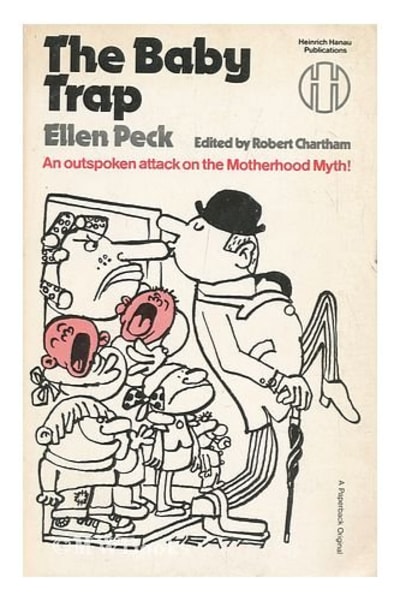
The Baby Trap — Book Summary & Review
by Ellen Peck
Last updated:
The Baby Trap Summary
Ellen Peck’s The Baby Trap is built around a simple, recurring mechanism: she argues that cultural messaging and economic incentives funnel women toward motherhood as their “only real growth,” then punish them for wanting anything else. Peck lays out how the trap is “set” by media images of endlessly happy babies and competent mothers, “filled” by the constant stream of idealized family scripts, and “baited” by manufacturers who profit from an expanding baby market. She also spends real time on the social side—relatives offering well-meant advice that reproduces their own regrets, and identity-hungry young women interpreting pregnancy as a shortcut to belonging or usefulness. Peck’s central claim is that children don’t automatically ruin marriages, but they absolutely reorder emotional balance: less time, less spontaneity, and often a narrowing of sexuality and shared life. She treats fatherhood as part of the same equation, pointing to mounting bills and the long, two-decade obligations that can drain a man’s sense of partnership. What makes Peck feel grounded is that she doesn’t write motherhood as pure villainy; instead she argues that the “myth” is what’s dangerous, because it erases alternatives and makes childfree women look like a threat to the story everyone else benefits from. One concrete example she returns to is the way “idealized families” function like a marketing channel, training expectations before anyone has a chance to negotiate what they actually want. Another is her insistence that “something to offer” a husband becomes a trapdoor: the woman’s identity shrinks to caretaking, and the marriage becomes a logistics project. Limitation: The Baby Trap reads like a product of its 1971 moment—less data-driven than modern readers expect, and it offers fewer nuanced case studies of diverse family structures than contemporary psychology books.
Key Takeaways from The Baby Trap
-
1
Baby Trap framework: Peck maps motherhood pressure as a staged process—set, filled, baited—by culture and incentives shaping choices.
-
2
Motherhood Myth: The idea that children are the required path to fulfillment; Peck shows how it crowds out other adult identities.
-
3
Media images: Peck treats baby-centered storytelling as training material that normalizes lost sexuality and reduced couple time.
-
4
Manufacturers for whom babies mean profits: She argues consumer markets benefit from constant demand and reinforce “healthy” family norms.
-
5
Alternatives to motherhood: Peck insists freedom of choice exists, but requires resisting scripts that label childfree women threatening.
Who Should Read This
Someone who feels the “default” plan around them is marriage then pregnancy, and you’re starting to resent how little choice you’re allowed. If you’re navigating a relationship where kids are being framed as the only route to love, identity, or social approval, this will sharpen your thinking.
Who Shouldn't Read This
If you want modern research citations, careful methodology, and contemporary terminology, Peck will feel dated and a bit blunt. If you’re looking for a warm, personal memoir voice with lots of lived-in scenes, The Baby Trap is more argumentative than intimate.
Editor's Verdict
The best thing Ellen Peck does is name the machinery behind the “motherhood myth,” especially in her media-and-market argument about how the Baby Trap is set and baited. The real limitation is that the book is more polemic than evidence-heavy psychology, so some readers will wish for modern studies and broader demographic nuance. If you’re a woman or partner in your twenties or early thirties who’s watching pregnancy expectations tighten around your relationship, this hits hardest right before you treat parenthood as inevitability rather than a decision.
Ready to read The Baby Trap?
Get your copy on Amazon today.
The Baby Trap — Frequently Asked Questions
About Ellen Peck
Ellen Peck is an author and journalist who has written extensively about pregnancy, childbirth, and parenting. She is credible on the topic of reproductive decision-making and family planning through her reporting and long-form research on how medical and social systems affect pregnancy outcomes and parental choices. Peck’s work includes The Baby Trap and other nonfiction writing focused on family life and health.