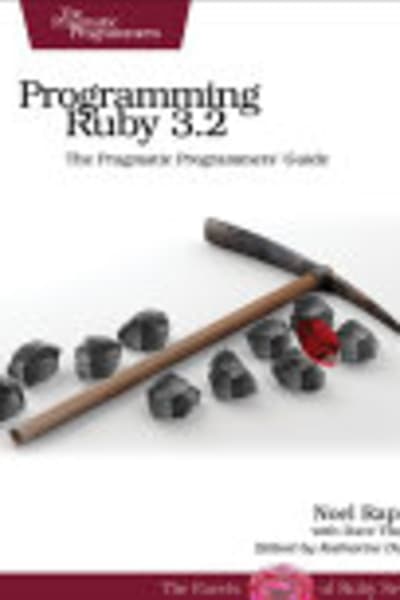
Programming Ruby 4 — Book Summary & Review
Last updated:
Programming Ruby 4 Summary
Programming Ruby 4 opens by laying down a practical roadmap: the book builds Ruby from the inside out, starting with core syntax and moving toward idioms, testing, and real-world structure. Thomas and Rappin keep repeating a theme that Ruby is best learned by writing small programs that grow into maintainable ones; you’re not meant to memorize features, you’re meant to internalize Ruby’s habits. One of the book’s most useful early moves is how it treats methods and blocks as the “control surfaces” of Ruby—once you understand how blocks flow through methods, everything from iteration to custom APIs starts clicking.
A concrete example: the chapter that covers “Modules and Mixins” doesn’t just explain inheritance alternatives; it shows how to package behavior and selectively share it, then ties that back to the way Ruby resolves method lookup at runtime. Later, the “Working with Files” sections are refreshingly grounded: you see how to open, read, and write files safely, and how Ruby’s IO objects shape the code you end up with. Thomas’s insistence on consistent style shows up repeatedly, especially when the book contrasts “what works” with “what Ruby devs expect.”
The book also leans hard on practical tooling—testing and refactoring are framed as part of your learning loop, not as an afterthought. If you follow Thomas and Rappin’s approach, you’ll end up with code that is easier to modify because you understand where behavior belongs (classes vs. modules) and how to structure it.
Honest limitation: this is not a fast, beginner-only crash course, and it won’t rescue you if you want a purely conceptual explanation of programming fundamentals. If you’re allergic to exercises and want only theory, Rappin’s and Thomas’s “write it, run it, adjust it” method will feel demanding.
Key Takeaways from Programming Ruby 4
-
1
Ruby blocks: Learn to treat blocks as the primary way to customize behavior passed into methods.
-
2
Modules and Mixins: Use mixins to share behavior without committing to rigid inheritance hierarchies.
-
3
Method lookup: Understand how Ruby finds methods at runtime so your composition choices don’t surprise you later.
-
4
Working with Files: Grasp Ruby’s IO objects and patterns for reading and writing without turning scripts into spaghetti.
-
5
Testing and refactoring: Practice small red-green cycles so your learning improves your design, not just your output.
Who Should Read This
If you’re writing Ruby code that “works” but feels fragile whenever requirements change, Someone who needs structure and idioms will benefit. If you just started building a small app and keep getting stuck on where behavior should live—classes, modules, or methods—this helps you make those calls.
Who Shouldn't Read This
If you want a purely conceptual overview with minimal coding, Programming Ruby 4 will frustrate you because Thomas and Rappin push learning through doing. If you already know Ruby well and want advanced framework-specific guidance, the book’s generalist pacing will feel too basic and slow.
Editor's Verdict
Programming Ruby 4’s best strength is its insistence that Ruby’s blocks and mixins aren’t optional trivia—see “Modules and Mixins,” where the runtime behavior and organization choices finally line up. The real limitation is that it’s broad and exercise-driven, so it won’t satisfy readers who want quick, theory-only explanations or deep coverage of one specific ecosystem. This hits hardest for someone mid-learning who keeps rewriting the same small program because they don’t yet trust their structure decisions.
Ready to read Programming Ruby 4?
Get your copy on Amazon today.
Programming Ruby 4 — Frequently Asked Questions
About Noel Rappin, Dave Thomas
Noel Rappin is a software developer and educator known for his work on Ruby and Rails. He has contributed to the Ruby community through writing and teaching, including practical guidance on Ruby programming. Dave Thomas is a co-creator of Ruby and a longtime software engineer and author. He is credible on Ruby because he helped design the language and has extensive experience teaching and writing about it. Other notable works include Programming Ruby and The Pragmatic Programmer.