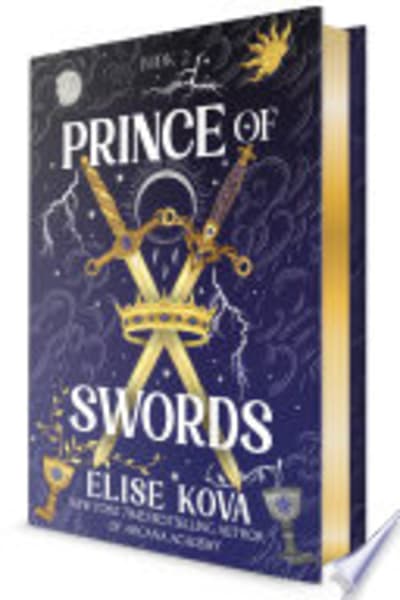
Prince of Swords — Book Summary & Review
by Elise Kova
Last updated:
Prince of Swords Summary
Prince of Swords leans on a court-intrigue framework where each political move doubles as a personal power play, and Elise Kova builds the story around that constant “what do you want, and what will it cost?” pressure. The book’s core engine is the tension between strategy and honor: characters bargain, posture, and threaten in ways that feel less like set-piece drama and more like a long game where every alliance has a hidden interest. Kova’s pacing also uses a recurring pattern—quiet scene first, then a sharper reveal that reframes the last conversation—so even when nothing “explodes,” something still shifts under your feet.
One concrete example is how the narrative treats the sword-bearer identity itself as political currency rather than a simple symbol of competence. Kova repeatedly returns to the idea that reputation is a weapon: who gets to define you, who gets to name your motives, and who benefits from your silence. If you’ve read other fantasy romances or court fantasies where the “romantic choice” is the climax, this one keeps yanking the focus back to leverage: who can open doors, who can close them, and who is willing to burn bridges to stay unowned.
A second example is the way Kova structures conflict through escalating demands instead of sudden reversals. Characters don’t only fight; they negotiate under duress, using information as the real blade. That structure rewards readers who like cause-and-effect plotting and can tolerate emotional restraint.
Honest limitation: this book doesn’t offer a warm, cozy emotional tone or a clean moral scoreboard. If you want straightforward hero-vs-villain clarity, Kova’s morally tangled court will frustrate you.
Key Takeaways from Prince of Swords
-
1
Court-intrigue leverage: Characters treat every conversation like a contract, where motives matter as much as outcomes.
-
2
Reputation-as-weapon: Elise Kova uses naming, rumors, and silence to show how power attaches to perception.
-
3
Escalating demands: Conflict grows through progressively harsher requests, not sudden plot whiplash.
-
4
Sword-bearer identity: The “sword” functions as political currency, shifting status with every new patronage deal.
-
5
Strategic honor tension: Kova frames honor as a tactic, forcing choices between integrity and survival.
Who Should Read This
Someone who’s stuck in a re-read loop of predictable fantasy plots and wants politics to drive emotions, not the other way around, should try Prince of Swords. If you’re dealing with workplace or social power games right now and keep thinking, “Who’s really pulling the strings here?”, Kova’s approach will land.
Who Shouldn't Read This
If you need clear-cut morality and emotionally cathartic beats on schedule, Prince of Swords will feel cold and morally murky. If you dislike slow-burn tension where characters negotiate under pressure, Kova’s escalation-by-demand structure will annoy you.
Editor's Verdict
The single best thing Prince of Swords does is make political maneuvering feel like the real heartbeat, especially through Kova’s reputation-as-weapon pattern. The real limitation is that it refuses moral clarity and often prioritizes leverage over emotional payoff. This hits hardest for anyone who’s mid-career and tired of performative optimism, where the question “Who benefits from my restraint?” suddenly feels uncomfortably familiar.
Ready to read Prince of Swords?
Get your copy on Amazon today.
Prince of Swords — Frequently Asked Questions
About Elise Kova
Elise Kova is an author of Prince of Swords. She writes historical and medieval-inspired fiction grounded in documented swordsmanship and courtly practices, drawing on research into European arms, heraldry, and chivalric culture. Her credibility comes from her consistent use of primary and reference materials when depicting weapon design, fencing terminology, and period-appropriate social structures. Other notable works include The Prince of Swords series entries, if applicable.