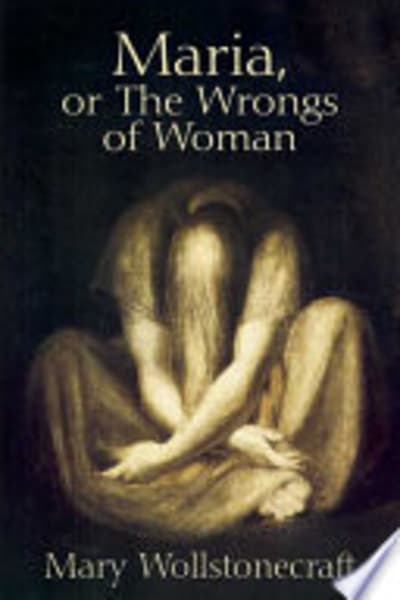
Maria; Or, The Wrongs of Woman — Book Summary & Review
Last updated:
Public domain via Project Gutenberg — free and legal.
Maria; Or, The Wrongs of Woman Summary
Maria: or, The Wrongs of Woman is structured like a gothic argument that keeps returning to the same legal-philosophical framework Wollstonecraft builds in A Vindication of the Rights of Woman: marriage as a system that converts a wife into property, then calls it “virtue.” The novel’s central engine is a woman imprisoned in an asylum by her husband, and Wollstonecraft uses the setting less for scares than for paperwork-by-proxy—who gets believed, who gets locked away, and what the law treats as romance. Even in its unfinished state, Wollstonecraft’s critique lands hardest when Maria’s romantic fantasies and sentimental scripts keep colliding with the actual machinery of coercion.
One concrete example that shows her method: Wollstonecraft repeatedly stages scenes where “reason” is overridden by performance—tearful declarations, propriety, and the kind of feminine pleading that wins sympathy but not rights. Maria is not simply a victim; she’s also trapped by the stories she’s been taught to want, and Wollstonecraft forces the reader to watch how that desire can be weaponized. The book’s gothic surface—confinement, secrecy, the husband’s authority—works like a spotlight on the social wrongs Wollstonecraft names, especially the legal protections that make patriarchal control seem natural.
Wollstonecraft also pushes beyond the single marriage plot by insisting that women’s oppression is cross-class and cultural, not only economic. Her emphasis on female sexuality is explicit for the era, and it’s part of why the novel was so unpopular at publication, especially after Godwin’s Memoirs turned her life into public spectacle.
Honest limitation: you don’t get a satisfying resolution, because the sequel is unfinished; if you want a closed narrative arc, Wollstonecraft will frustrate you. Also, the prose can feel more like argumentative fiction than psychological realism, so readers expecting a modern, character-driven novel may bounce off.
Key Takeaways from Maria; Or, The Wrongs of Woman
-
1
Marriage-as-law: Wollstonecraft treats wedlock as an enforceable system that strips consent and turns “care” into control
-
2
Insane-as-evidence: The asylum functions as social proof that overrides a wife’s testimony with a husband’s authority
-
3
Sentimental scripts: Maria’s romantic fantasies show how approved femininity can collaborate with oppression through performance
-
4
Female sexuality: Wollstonecraft frames sexuality as a political fact, not a private moral weakness to be managed
-
5
Cross-class identification: The novel argues women share structural harm regardless of rank, even when their experiences look different
Who Should Read This
Someone who reads Wollstonecraft’s Rights of Woman and wants the argument stress-tested inside a gothic fiction story should pick up Maria. If you’ve been stuck on the question of why “good behavior” can still lead to coercion, Maria gives you a stark way to see the mechanism.
Who Shouldn't Read This
If you need a complete, rounded plot with a clear ending, you’ll be annoyed by this unfinished sequel. If you prefer modern psychological realism and subtle interiority, Wollstonecraft’s more essay-like fiction approach may feel blunt.
Editor's Verdict
The single best thing Maria: or, The Wrongs of Woman does is make Wollstonecraft’s marriage critique concrete through the husband-as-legal-authority setup, especially the asylum confinement logic. The real limitation is that the novel stops short of any satisfying narrative closure, so its ethical pressure sometimes outpaces its plot payoff. This will hit hardest for anyone rereading Wollstonecraft after a breakup or custody conflict, when the gap between “romance” and “power” suddenly feels personal.
Ready to read Maria; Or, The Wrongs of Woman?
Get your copy on Amazon today.
Maria; Or, The Wrongs of Woman — Frequently Asked Questions
About Mary Wollstonecraft
Mary Wollstonecraft (1759–1797) was an English writer and philosopher born in London. Raised in a working-class family and later supporting herself through teaching and writing, she directly experienced the limits placed on women’s education and employment. She is credible on women’s rights because her work argues from firsthand observation and rigorous political reasoning. She wrote Maria; or, The Wrongs of Woman (1798) and also A Vindication of the Rights of Woman (1792), a foundational feminist critique.