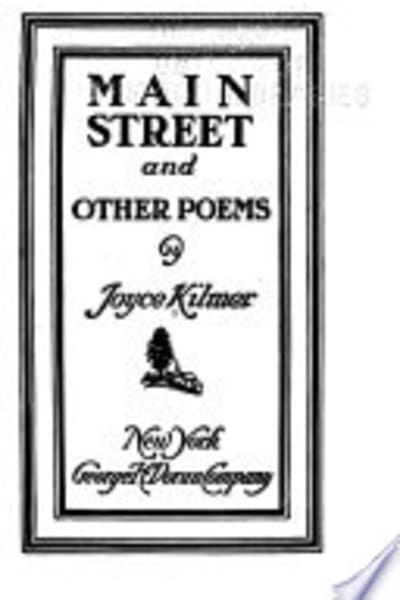
Main Street, and Other Poems — Book Summary & Review
by Joyce Kilmer
Last updated:
Public domain via Project Gutenberg — free and legal.
Main Street, and Other Poems Summary
Main Street, and Other Poems is a slim 1917 poetry collection where Joyce Kilmer leans hard on hymnlike rhythms and plainspoken scenes—especially the title piece “Main Street”—to argue that everyday life can carry moral weight. The poems are arranged like a set of variations on the same conviction: the ordinary street, the churchyard hush, the child’s wonder, and the small gestures of community are treated as evidence that beauty and faith belong in the same room. In “Main Street,” Kilmer builds his case by stacking concrete particulars—storefronts, neighbors, familiar routines—until the scene feels less like geography and more like a creed you can walk through. Several shorter poems then echo that method, trading plot for mood but keeping the same goal: make reverence feel close enough to touch.
Kilmer’s voice is consistently earnest, sometimes bordering on sermon. He rarely complicates his stance; instead, he repeats it through image after image, as if the poems are practicing the same lesson at different distances. The collection’s strongest moments are when the language stays simple and the picture stays steady—when a poem doesn’t try to surprise you, it tries to reassure you. That’s also the limitation: if you want modern irony, formal experimentation, or emotional ambiguity, Kilmer’s approach will feel narrow and dutiful.
If you’re expecting a story arc or a dramatic turn, you won’t get one—this book is made of standalone lyrics. And if you’re tired of early-20th-century moralizing verse, you may find the repetition wearing. Kilmer’s sincerity is real; it’s just not built to meet you halfway.
Key Takeaways from Main Street, and Other Poems
-
1
“Main Street” treats ordinary scenery as moral proof, turning everyday routines into something like a lived prayer.
-
2
Kilmer’s hymnlike meter favors steadiness over surprise, so poems often read as affirmations rather than arguments.
-
3
Community imagery (neighbors, shops, familiar streets) functions as the collection’s recurring “evidence,” not background decoration.
-
4
Plain diction is the strategy: Kilmer avoids abstraction so the reader can “see” the lesson instead of infer it.
-
5
Standalone lyrics mean there’s no cumulative plot, so your enjoyment depends on how well you like each mood.
Who Should Read This
Someone who misses poetry that sounds like church bells—clear, rhythmic, and quietly confident—will likely enjoy Kilmer’s plain scenes. If you’re in a season of wanting comfort and moral clarity after a rough stretch, this collection can match that need.
Who Shouldn't Read This
If you crave contemporary poetic experimentation—fractured syntax, irony, or ambiguity—Kilmer will feel rigid and predictable. If you’re sensitive to early-20th-century religious sentiment and don’t want it in your reading, this book will likely grate fast.
Editor's Verdict
The single best thing Main Street, and Other Poems does is make its central claim through the title poem “Main Street,” where Kilmer uses specific street-level details to build reverence from the ground up. The real limitation is that Kilmer’s sincerity stays in the same lane, leaving little room for complexity, irony, or formal risk. This hits hardest for someone who grew up on straightforward devotional verse and is revisiting it after years away, or for anyone seeking consolation when they don’t want to be challenged.
Ready to read Main Street, and Other Poems?
Get your copy on Amazon today.
Main Street, and Other Poems — Frequently Asked Questions
About Joyce Kilmer
Joyce Kilmer (1886–1918) was an American poet and essayist best known for “Trees.” He was born in New Brunswick, New Jersey, and raised in New York. Kilmer studied at St. John’s College and worked as a journalist and editor, writing widely on literature and public life. His credibility on poetry stems from his published verse and his role in early 20th-century American literary circles. Other notable works include The House of the Heart and Poems.