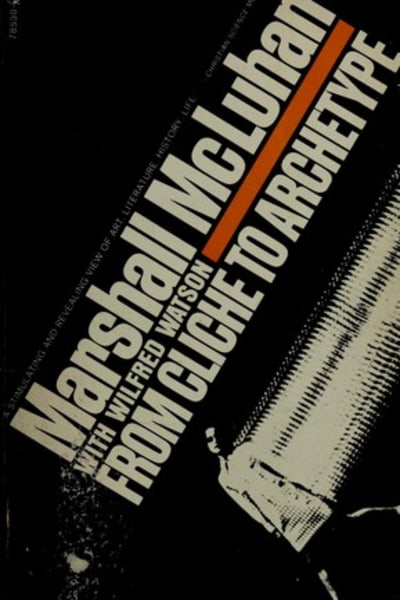
From Cliche to Archetype — Book Summary & Review
Last updated:
From Cliche to Archetype Summary
Marshall McLuhan’s From Cliché to Archetype is built around his insistence that a stereotype (the cliché people repeat) isn’t merely a bad idea—it’s a cultural form that can harden into an archetype. The book is short enough to feel like a series of lectures, but McLuhan’s central move is consistent: he treats media and language as engines that shape perception, then argues that research and criticism often miss the deeper pattern because they obsess over surface “content.” One of the book’s most useful sections is the chapter that lays out how clichés behave like social shortcuts: they survive because they reduce complexity, not because they’re logically true. McLuhan then pushes further, claiming that when you trace those shortcuts long enough, you find recurring archetypal roles—figures and expectations that cultures reuse across topics.
What makes McLuhan worth finishing is how he links this to communication. He doesn’t let you stay in “words are wrong” mode; he asks what the communication environment does to the mind. In that sense, McLuhan’s metaphor work matters: he treats figures of speech and recurring images as evidence of how groups organize experience. A concrete example he returns to is the way public discourse labels “types” of people, turning messy realities into stable labels that feel explanatory. That’s the cliché-to-archetype pipeline: a label starts as convenience, then becomes a template.
Honest limitation: McLuhan’s argument is more diagnostic than predictive—he doesn’t offer a step-by-step method for running your own stereotype research, and his style can frustrate readers who want careful data, citations, and clear counterarguments.
Key Takeaways from From Cliche to Archetype
-
1
Cliché-to-archetype: McLuhan treats repeated stereotypes as reusable cultural templates, not just sloppy beliefs.
-
2
Archetype as pattern: Archetypes are the recurring roles a culture assigns, which persist even when topics change.
-
3
Media shaping perception: Communication environments steer what feels “obvious,” so language errors often reflect system-level habits.
-
4
Metaphor as evidence: McLuhan reads recurring figures of speech as signs of how groups structure reality in the mind.
-
5
Research blind spots: McLuhan criticizes studies that chase surface content while ignoring the deeper form stereotypes carry.
Who Should Read This
If you keep arguing with friends or coworkers about “types” of people and realize the same labels keep winning, this book will sharpen your diagnosis. Someone who’s stuck in the cycle of noticing stereotypes but can’t explain why they feel so stable will find McLuhan’s framework useful.
Who Shouldn't Read This
If you want a rigorous, citation-heavy psychology text with testable hypotheses, McLuhan will feel frustratingly airy and uneven. If you’re looking for practical tools to measure stereotypes in a study, From Cliché to Archetype won’t give you a usable protocol.
Editor's Verdict
The single best thing McLuhan does is reframe stereotypes as forms that evolve into archetypes, especially through his cliché behavior and communication-focused argument. The real limitation is that the book rarely slows down for method, data, or falsifiable predictions, so you’ll be left with interpretation rather than a tool. If you’re mid-career and tired of debating culture as “opinions,” this hits hardest when you’re trying to explain why certain labels keep surviving anyway.
Ready to read From Cliche to Archetype?
Get your copy on Amazon today.
From Cliche to Archetype — Frequently Asked Questions
About Marshall McLuhan
Marshall McLuhan (1911–1980) was a Canadian communication theorist and professor, educated at the University of Manitoba and Cambridge University. He became credible on media and meaning by studying how communication technologies shape perception and cultural patterns. His work directly addresses how repeated expressions become “clichés” and how deeper archetypal structures persist beneath them. Notable works include Understanding Media (1964) and The Gutenberg Galaxy (1962).