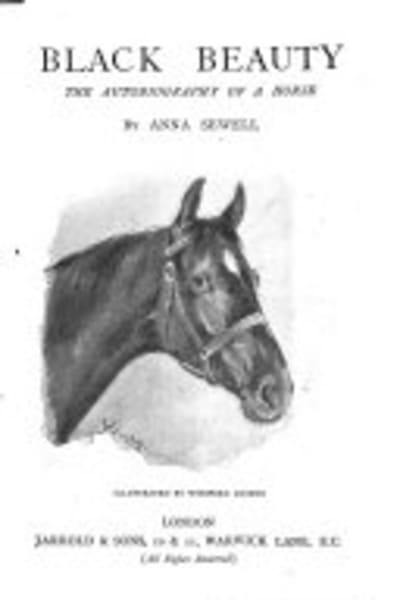
Black Beauty — Book Summary & Review
by Anna Sewell
Last updated:
Public domain via Project Gutenberg — free and legal.
Black Beauty Summary
Black Beauty is built as an animal “autobiography,” and the structure matters: Sewell (again, Sewell) lets the horse narrate not only what happens to him, but what it feels like when humans get careless, rushed, or cruel. You start with Black Beauty’s early lessons from his mother—how to behave, how to avoid biting or kicking even during play—and then watch those basics get tested once circumstances force sale after sale. The book keeps returning to that framework of cause and effect: a human decision becomes an animal consequence, sometimes immediate (a rough hand at the reins) and sometimes slow (pain that turns into bad behavior and then blame). One of the clearest concrete hinges is the “quiet” pattern of work versus the “mad” pattern of impatience; Sewell uses the difference to make the moral feel mechanical rather than sentimental. Another recurring device is the horse’s observation of caretakers: some are steady and attentive, others treat the animal as disposable equipment. A specific example that sticks with me is when Black Beauty is passed into new hands and the care changes overnight—better feeding and calmer handling versus neglect that shows up in his condition. Sewell also threads in Quaker-flavored ethics: hard work without complaint, restraint instead of violence, and kindness as a duty, not a mood. The story keeps insisting that horses can feel, even if they cannot speak, and it uses that gap to indict human habits of ignoring suffering. Honest limitation: this isn’t a modern psychological novel with nuance or ambiguity; it’s designed to teach, and the moral beats can feel blunt for anyone who wants subtlety, irony, or plot surprises rather than repeated lessons.
Key Takeaways from Black Beauty
-
1
Animal “autobiography” framing: Black Beauty narrates sensations and consequences, turning horse behavior into evidence of human choices.
-
2
Mother’s lessons: the early rules about biting and kicking establish a baseline of character before hardship scrambles it.
-
3
Sales and transfers: each change of owner functions like a stress test for the ethics of care and patience.
-
4
Quiet versus mad work: Sewell contrasts steady handling with hurried brutality to show how “attitude” becomes pain.
-
5
Quaker restraint and labor: hard work without complaint is presented as moral practice, not just temperament.
Who Should Read This
If you’ve ever felt uneasy about how animals are treated in everyday life—at stables, parks, or even just in media—Black Beauty will likely land hard. Someone who wants a straightforward, narrated morality story with real sensory details will enjoy how Sewell keeps tying behavior to feeling.
Who Shouldn't Read This
If you need complexity, ambiguity, or psychologically layered characters beyond the human/animal moral split, you may find Sewell’s teaching rhythm repetitive. If you’re allergic to overt lesson-drawing and want a faster, twisty plot, this 19th-century children’s classic will feel too orderly and too earnest.
Editor's Verdict
The single best thing Black Beauty does is make care and cruelty legible through the horse’s own testimony, especially in the repeated contrasts of handling styles that Sewell returns to across ownership changes. The real limitation is that the book is explicitly instructional, so the emotional argument can start to feel repetitive rather than evolving. This will hit hardest for anyone who grew up reading it as a child and now wants to judge whether the moral logic holds when you’re older and more skeptical.
Ready to read Black Beauty?
Get your copy on Amazon today.
Black Beauty — Frequently Asked Questions
About Anna Sewell
Anna Sewell (1820–1878) was an English novelist best known for Black Beauty. She was born in Great Britain and lived most of her life there, with firsthand experience of horses and their care. Her credibility comes from her close observation of working and riding horses and her concern for animal welfare, drawn from her own life circumstances. She published Black Beauty (1877). No other major novels are widely credited to her.