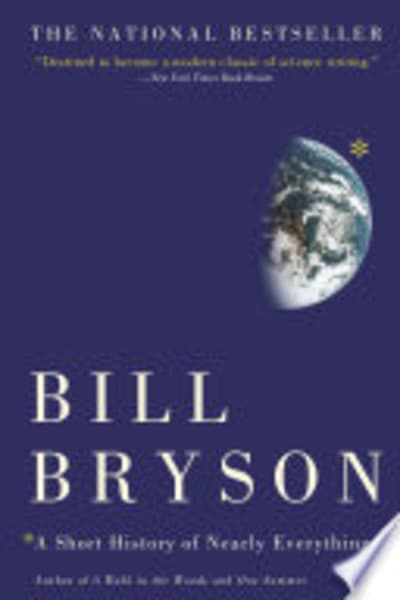
A Short History of Nearly Everything — Book Summary & Review
by Bill Bryson
Last updated:
A Short History of Nearly Everything Summary
Bryson's 'A Short History of Nearly Everything' opens by pondering the colossal odds against existence itself, a theme he unpacks with both humor and humility. The book is structured around the grand narrative of scientific discovery, featuring sections like 'The Mighty Atom,' which explores the heart of physical matter and our human curiosity about it. Bryson's strength lies in making complex scientific phenomena accessible, often using vivid analogies and anecdotes that keep the reader engaged. However, his attempt to cover such an expansive scope means that some topics are treated with less depth than specialists might desire. While Bryson excels in bringing science to the masses, those looking for highly technical explanations may leave wanting more detail.
Key Takeaways from A Short History of Nearly Everything
-
1
The Cosmic Lottery: Bryson uses this term to describe the improbability of life existing, emphasizing the miraculous nature of our universe.
-
2
The Mighty Atom: This section demystifies atomic theory, highlighting how atoms serve as the fundamental building blocks of everything.
-
3
The Periodic Table: Bryson explains its development and significance, making this complex tool approachable for non-scientists.
-
4
Einstein's Blunder: Refers to Einstein's cosmological constant, illustrating how even great minds make mistakes that lead to breakthroughs.
-
5
The Asteroid Impact: Details the event that caused the dinosaurs' extinction, showing how catastrophic events shaped Earth's history.
Who Should Read This
Someone who finds themselves fascinated by science but intimidated by textbooks will appreciate Bryson's engaging narrative style. If you're curious about how scientific discoveries impact everyday life, this book is a delightful entry point.
Who Shouldn't Read This
If you're seeking an in-depth, technical analysis of scientific theories, Bryson's approach may feel too surface-level. Also, anyone looking for a single-topic focus might find the book's broad scope overwhelming.
Editor's Verdict
Bryson's knack for storytelling shines in 'The Periodic Table,' making complex ideas approachable. Yet, the book's breadth can leave out the nuances specialists crave. Anyone just starting to explore science will find this book a welcoming guide that ignites curiosity.
Ready to read A Short History of Nearly Everything?
Get your copy on Amazon today.
A Short History of Nearly Everything — Frequently Asked Questions
About Bill Bryson
Bill Bryson, born in 1951 in Des Moines, Iowa, is a renowned author known for his ability to make complex subjects accessible. Although not formally trained as a scientist, his extensive research and engaging writing style lend credibility to "A Short History of Nearly Everything," which explores scientific topics for a general audience. Bryson is also known for "A Walk in the Woods" and "Notes from a Small Island," showcasing his versatility in travel and science writing.